Bakery Ovens 101: Deck, Convection, Asian, European & Retarder-Proofer Basics
Bakery Ovens 101: Deck, Convection, Asian, European & Retarder-Proofer Basics
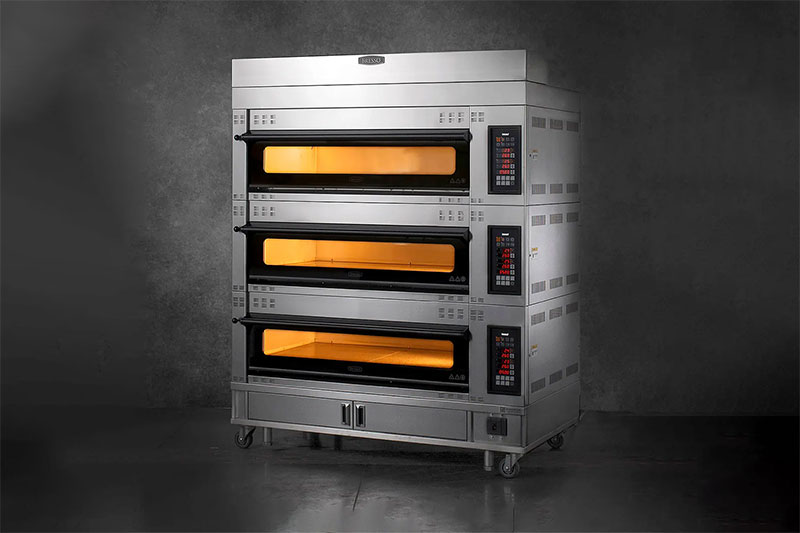
Commercial bakery ovens are not one product. The word "oven" covers machines that heat a baking chamber from a stone deck, machines that push hot air through a cabinet, machines built around European 600 x 400 mm trays, machines built for Asian soft-bread baking, and machines that only proof dough — never bake it at all.
This explainer is a category and vocabulary primer for buyers at the research and evaluation stage. It defines the oven types that are most often confused, shows the specification fields that actually determine which category a machine belongs to, and anchors the definitions in real BRESSO model families — the HCV convection series, the HBVO Asian deck oven, the HBWO European deck oven, the HBDC Air and HBDC Pro retarder-proofers, and the Champions League MAX Series — so that the terminology stays concrete rather than abstract.
Bakery ovens Deck oven Convection oven Retarder-proofer Commercial bakery shopWhy Bakery Oven Vocabulary Is Harder Than It Looks
Three specific problems make bakery oven research harder than it should be.
First, the same word carries different meanings. "Deck" can mean the baking chamber itself, the number of independently controlled levels, or the count of trays that fit inside. A machine described as 3 decks, 12 trays and a machine described as 12 decks, 12 trays both exist — but they behave differently, take different footprints, and serve different production patterns. When a buyer reads "deck" without checking which meaning the supplier intends, the specification looks simpler than it is.
Second, tray standards are regional. European deck ovens are commonly specified around the 600 x 400 mm tray format (an EN reference), while ovens built for Asian bread and cake styles are usually described by tray count without a fixed tray standard attached. Buyers who assume the two are interchangeable will mis-plan both footprint and throughput before a single quotation is issued.
Third, three separate decisions are routinely collapsed into one. Heat source (electric or gas), airflow (still-air deck or moving-air convection), and dough preparation (proofing and retarder-proofing) are three different layers of a bakery equipment plan. Treating them as one question is the most common source of mis-bought equipment in this category.
Where This Vocabulary Sits in the Market
The category is large and increasingly electric. Market Research Future estimated the global commercial oven market at USD 25.45 billion in 2024, and projected that electric ovens would account for 57.8% of commercial oven market revenue in 2025. For a bakery operator, that shift changes the default planning assumption: electricity is no longer the alternative model — it is the mainstream one in new kitchen planning.
Equipment expectations have hardened alongside that shift. Commercial bakery ovens are typically required to run in high-temperature, high-humidity kitchen environments, and to meet local safety and sanitation standards. Stainless steel construction and compliance with European and American commercial equipment standards recur as baseline requirements rather than premium options, and 20/7 operating patterns are common in commercial bakery shops, hotel kitchens, restaurant bakeries, employee cafeterias, and coffee shops.
BRESSO is a bakery equipment brand established in 1991 in Seoul, South Korea, with a Shanghai production base added in 2017. Its publicly presented portfolio covers European-style ovens, Korean-style ovens, convection ovens, and proofers — which makes the brand's model range a useful reference set for the categories a first-time buyer needs to learn.
The Bakery Oven Categories, Defined
Deck Ovens: Heat From a Stone Deck
A deck oven bakes on a flat heated surface, usually a stone or steel deck, with one or more independent levels stacked vertically. Each deck normally has its own temperature control and exhaust, which is what allows different products to bake at different temperatures at the same time. Deck ovens are the traditional category for crusty breads, artisan loaves, baguettes, and pastries where bottom heat and radiant heat matter to crust development.
Within deck ovens, the supplier vocabulary often splits by the tray system the oven was designed around. Two categories dominate that split.
Asian Ovens (HBVO Series)
"Asian oven" is a commercial bakery term for deck ovens configured for the soft-bread, milk-bread, bun, and cake baking patterns common in East and Southeast Asian bakeries. The BRESSO Asian Oven family carries the HBVO model code, and its specifications are expressed in decks and tray counts:
- HBVO-2003 — 3 decks, 6 trays; overall dimension L1330 x D1200 x H2065 mm; 380V / 15 kW
- HBVO-3003 — 3 decks, 9 trays; overall dimension L1730 x D1420 x H2065 mm; 380V / 24 kW
- HBVO-4003 — 3 decks, 12 trays; overall dimension L1730 x D1200 x H2065 mm; 380V / 27 kW
All three share the same 2065 mm height, which matters for kitchen planning: the horizontal spread grows with tray count, not the vertical profile. The range is built in stainless steel and applies to baking equipment and bread-making equipment projects, serving bakery, hotel, restaurant, and coffee shop sectors.
European Ovens (HBWO Series)
"European oven" describes deck ovens designed around the EN 600 x 400 mm tray format and the crusty, artisan baking patterns associated with European bakery practice. The BRESSO European Oven family carries the HBWO model code, and unlike the Asian series, its capacity is written as trays-per-deck multiplied by decks:
- HBWO-2003 — EN600 x 400 mm; 2 trays x 3 decks = 6 trays; overall dimension L1120 x D1310 x H2065 mm; 380V / 12.4 kW
- HBWO-3003 — EN600 x 400 mm; 3 trays x 3 decks = 9 trays; overall dimension L1500 x D1310 x H2065 mm; 380V / 16.1 kW
- HBWO-4003 — EN600 x 400 mm; 4 trays x 3 decks = 12 trays; overall dimension L1500 x D1495 x H2065 mm; 380V / 20.2 kW
The pattern to notice is that all three European configurations keep three decks and grow tray count per deck, while the Asian series keeps three decks and grows total tray count through width. Both are three-deck families, but they scale in different directions — which is exactly the kind of detail a spec sheet alone will not explain.
Convection Ovens (HCV Series)
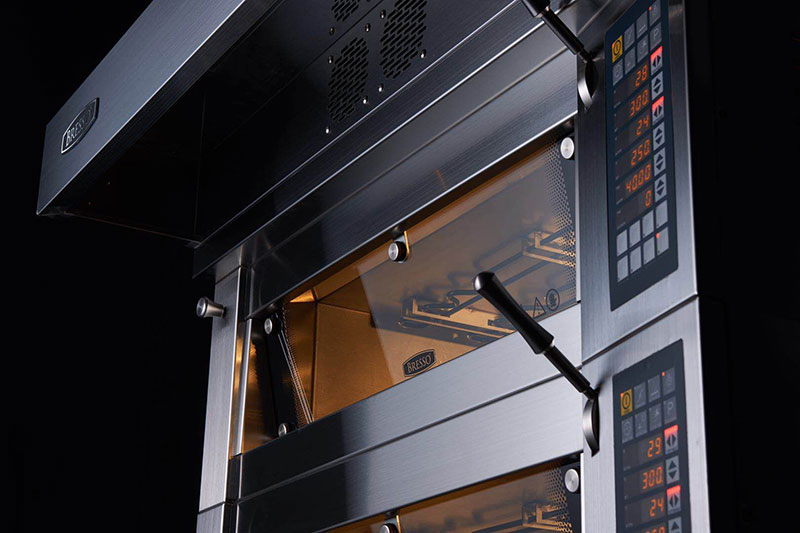
A convection oven bakes by circulating hot air through the chamber with a fan, rather than relying mainly on radiant heat from a deck. The moving air evens out temperature across the cabinet, which reduces the need to rotate trays mid-bake and helps delicate products hold their shape. Convection ovens are commonly used for pastries, croissants, Danishes, cookies, and layered baked goods where uniform colour across the tray is the target.
The BRESSO convection range is the HCV family, described in the same deck-and-tray vocabulary as the deck ovens:
- HCV-5 AIR — 5 decks, 5 trays; L1900 x D1220 x H2065 mm; 380V / 9 kW
- HCV-5+5 AIR — 2 decks, 10 trays; L1900 x D1340 x H2065 mm; 380V / 18 kW
- HCV-6S — 6 decks, 6 trays; L900 x D1340 x H2065 mm; 380V / 10.5 kW
- HCV-10S — 10 decks, 10 trays; L900 x D1220 x H2065 mm; 380V / 21 kW
Two things stand out in that list. First, the HCV-6S and HCV-10S hold the narrowest footprint in the range at 900 mm width while stacking the most decks, which is why they are often discussed in space-constrained urban bakery layouts. Second, all four models share the 2065 mm height, so vertical clearance planning stays consistent across the convection family.
Retarder-Proofers (HBDC Series)
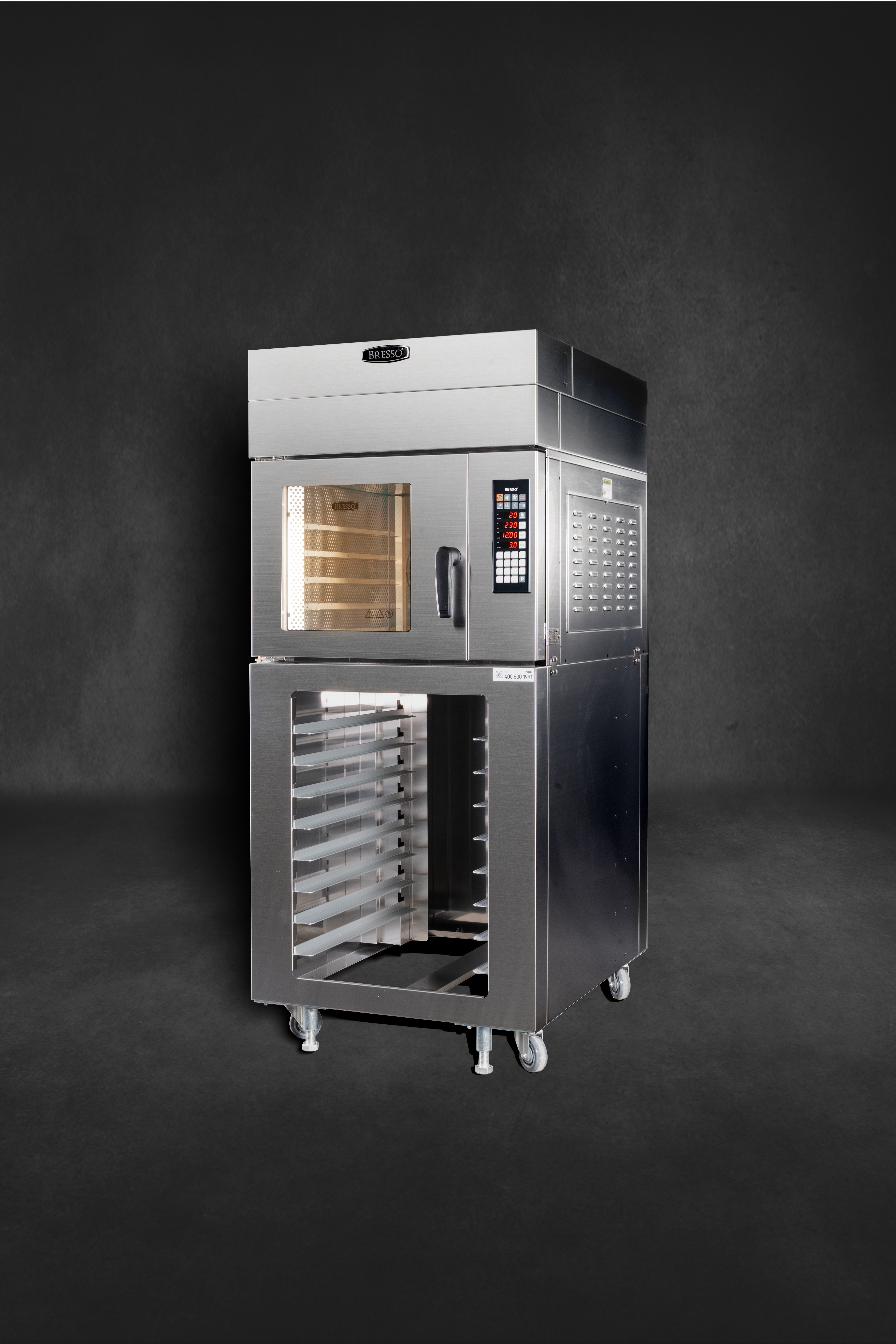
A retarder-proofer is not a baking oven. It is a climate-controlled cabinet that holds dough at low temperature (retarding, i.e. chilled or frozen holding) and then warms and humidifies it to proof before baking. In a bakery workflow, the retarder-proofer sits between the mixer and the oven, and it is what enables bakeries to prepare dough overnight and bake in a controlled morning sequence.
BRESSO offers two retarder-proofer series — HBDC Air and HBDC Pro — and in the published specifications the two families share the same core capacities, dimensions, and power figures:
- HBDC-2018 — 18 trays; L600 x D955 x H2065 mm; 220V / 2 kW
- HBDC-2032 — 32 trays; L780 x D1220 x H2065 mm; 220V / 2 kW
- HBDC-1618 — 16 trays chilled / 18 trays frozen; L780 x D1220 x H2065 mm; 220V / 2 kW
Each of these appears in both the Air and the Pro series — for example HBDC-2018AIR and HBDC-2018PRO, or HBDC-2032AIR and HBDC-2032PRO. Across every listed variant, the cabinet runs on 220V / 2 kW, which is a much lower electrical draw than the 380V baking ovens and is a detail that catches buyers off-guard when they assume every unit in a bakery line needs the same supply.

A High-Output Reference Point: Champions League MAX Series
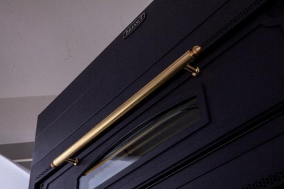
Not every bakery oven fits neatly into the deck / convection / proofer trio. The Champions League MAX Series Oven HBVO-400ЗMAX-ZS3 is a stainless steel high-output configuration with a capacity of 4 trays x 3 decks = 12 trays, an overall dimension of L1930 x D3100 x H2250 mm, and a power rating of 380V / 27 kW. Its depth — 3100 mm, compared with the 1200–1495 mm of the standard deck ovens — is the clearest illustration in the range of how much floor depth a higher-output configuration can consume. It is designed for 20/7 operation and applies to baking equipment and bread-making equipment projects in bakery, hotel, restaurant, and coffee shop sectors.
How to Read a Bakery Oven Spec Sheet
With the categories defined, the specification fields become far easier to interpret. A short sequence covers most of what a first-time buyer needs.
- Check whether "deck" means levels or trays. Compare the two numbers. If decks and trays match one-to-one, the oven is likely one tray per level. If trays exceed decks, multiple trays sit on each level. The HBWO-4003 uses 4 trays x 3 decks, while the HBVO-4003 uses 3 decks and 12 trays — same tray total, different distribution.
- Identify the tray standard. If the specification names a tray size (for example EN600 x 400 mm on the HBWO series), the oven's real capacity is tied to that tray. If it does not, ask before comparing capacity figures across suppliers.
- Read voltage and power together, never separately. Deck ovens and the Champions League MAX Series run on 380V, while the retarder-proofers run on 220V. Power draw varies widely even at the same voltage — from 9 kW on the HCV-5 AIR to 27 kW on the HBVO-4003 and HBVO-400ЗMAX-ZS3. Electrical planning depends on the pair, not the voltage alone.
- Plan floor depth, not just width. Across the BRESSO deck and convection families, height is held at 2065 mm, so vertical clearance is the stable variable. Depth is the variable that moves most: 1200 mm for HBVO-2003, 1495 mm for HBWO-4003, and 3100 mm for the Champions League MAX Series. Depth is where layout surprises appear.
- List paired equipment. A bakery oven rarely operates alone. Retarder-proofers, dough mixers, and other commercial kitchen equipment are commonly specified alongside the ovens, and the proofer power supply (220V) differs from the oven supply (380V), which affects panel planning.
Which Bakery Oven Category Fits Which Bakery Scenario
The category definitions above become useful once they are mapped to actual bakery settings. The commercial bakery shop is the most common context, but the right category depends on what is being baked and how often.
- Small urban or mall bakeries with limited space: the narrow-footprint convection models (HCV-6S and HCV-10S at 900 mm width) concentrate baking capacity vertically rather than horizontally. This is the configuration that appears in retail sites where floor area is the limiting factor.
- Bakeries baking soft bread, milk bread, buns and cakes: the Asian Oven HBVO family is designed around that product profile. The HBVO-2003 (3 decks, 6 trays) suits a compact shop, while HBVO-3003 and HBVO-4003 scale to 9 and 12 trays.
- Artisan and crusty bread bakeries: the European Oven HBWO family, built around EN 600 x 400 mm trays, is the deck configuration matched to baguettes, sourdough and crusty European breads.
- Bakeries producing pastries, croissants and Danishes: convection airflow suits delicate layered products, where even colour across the tray is the outcome the baker is managing.
- Bakeries running an overnight-to-morning bake sequence: a retarder-proofer is the enabling unit. The HBDC 18-tray cabinet (L600 x D955 x H2065 mm) fits a small back-of-house; the 32-tray cabinet scales with volume.
- High-output production bakeries and central kitchens: the Champions League MAX Series Oven — 12 trays at 380V / 27 kW, 20/7 duty — represents the top end of the configuration range.
Across all of these scenarios, stainless steel construction and 20/7 operating patterns are the recurring constants rather than the exceptions, and the equipment is expected to perform in the high-temperature, high-humidity conditions normal in commercial kitchens.
Bakery Oven Category Comparison Tables
The tables below consolidate the category specifications discussed above. They are included as reference, not as a buying ranking.
Convection Ovens (HCV Series)
| Model | Capacity | Overall Dimensions (mm) | Voltage / Power |
|---|---|---|---|
| HCV-5 AIR | 5 decks, 5 trays | L1900 x D1220 x H2065 | 380V / 9 kW |
| HCV-5+5 AIR | 2 decks, 10 trays | L1900 x D1340 x H2065 | 380V / 18 kW |
| HCV-6S | 6 decks, 6 trays | L900 x D1340 x H2065 | 380V / 10.5 kW |
| HCV-10S | 10 decks, 10 trays | L900 x D1220 x H2065 | 380V / 21 kW |
Deck Ovens: Asian (HBVO) and European (HBWO)
| Model | Category | Capacity | Overall Dimensions (mm) | Voltage / Power |
|---|---|---|---|---|
| HBVO-2003 | Asian Oven | 3 decks, 6 trays | L1330 x D1200 x H2065 | 380V / 15 kW |
| HBVO-3003 | Asian Oven | 3 decks, 9 trays | L1730 x D1420 x H2065 | 380V / 24 kW |
| HBVO-4003 | Asian Oven | 3 decks, 12 trays | L1730 x D1200 x H2065 | 380V / 27 kW |
| HBWO-2003 | European Oven | EN600 x 400 mm; 2 trays x 3 decks = 6 trays | L1120 x D1310 x H2065 | 380V / 12.4 kW |
| HBWO-3003 | European Oven | EN600 x 400 mm; 3 trays x 3 decks = 9 trays | L1500 x D1310 x H2065 | 380V / 16.1 kW |
| HBWO-4003 | European Oven | EN600 x 400 mm; 4 trays x 3 decks = 12 trays | L1500 x D1495 x H2065 | 380V / 20.2 kW |
| HBVO-400ЗMAX-ZS3 | Champions League MAX Series | 4 trays x 3 decks = 12 trays | L1930 x D3100 x H2250 | 380V / 27 kW |
Retarder-Proofers (HBDC Air and HBDC Pro)
| Capacity Variant | Series | Overall Dimensions (mm) | Voltage / Power |
|---|---|---|---|
| 18 trays (HBDC-2018AIR / HBDC-2018PRO) | HBDC Air / HBDC Pro | L600 x D955 x H2065 | 220V / 2 kW |
| 32 trays (HBDC-2032AIR / HBDC-2032PRO / HBDC-2032SAIR / HBDC-2032SPRO) | HBDC Air / HBDC Pro | L780 x D1220 x H2065 | 220V / 2 kW |
| 16 trays chilled / 18 trays frozen (HBDC-1618AIR / HBDC-1618PRO) | HBDC Air / HBDC Pro | L780 x D1220 x H2065 | 220V / 2 kW |
Material across both deck series, the convection series, the retarder-proofers and the Champions League MAX Series is stainless steel.
Frequently Asked Questions
A deck oven bakes on a heated flat deck, with each stacked level functioning as a separate baking chamber at its own temperature. A convection oven bakes by circulating hot air through the cabinet with a fan. Deck ovens are typically used for crusty breads and artisan loaves where bottom and radiant heat shape the crust; convection ovens are typically used for pastries, croissants, Danishes and layered products where even browning across a tray matters most. BRESSO's deck families include the Asian Oven HBVO and the European Oven HBWO; the convection family is the HCV series (HCV-5 AIR, HCV-6S, HCV-10S).
These terms describe the baking pattern a deck oven is designed around, not the country of manufacture. Asian Ovens such as the BRESSO HBVO series are configured for soft bread, milk bread, buns and cakes, with capacity expressed as decks and tray count. European Ovens such as the BRESSO HBWO series are built around the EN 600 x 400 mm tray format and are typically used for crusty and artisan breads, with capacity expressed as trays per deck multiplied by decks.
A retarder-proofer is a climate-controlled cabinet that holds dough at low temperature and then provides warm, humid conditions for proofing before baking. It does not bake — it prepares dough. A bakery needs one when it wants to prepare dough in advance and bake on a controlled schedule rather than proofing in a warm room. The BRESSO HBDC Air and HBDC Pro series cover 18-tray, 32-tray, and 16-tray chilled / 18-tray frozen configurations, all running on 220V / 2 kW.
In the BRESSO range, baking ovens run at 380V, while retarder-proofers run at 220V / 2 kW. Power draw among the 380V ovens varies significantly by configuration: HCV-5 AIR is 9 kW, HCV-6S is 10.5 kW, HBWO-2003 is 12.4 kW, HBVO-2003 is 15 kW, HBWO-3003 is 16.1 kW, HCV-5+5 AIR is 18 kW, HBWO-4003 is 20.2 kW, HCV-10S is 21 kW, HBVO-3003 is 24 kW, and both the HBVO-4003 and the Champions League MAX Series Oven HBVO-400ЗMAX-ZS3 are rated at 27 kW. Voltage alone does not determine electrical planning — the voltage and power pair does.
Start by matching the oven category to the product range, then confirm the specification fields: deck and tray count, tray standard, voltage and power, footprint, and paired equipment such as a retarder-proofer. BRESSO is a bakery equipment brand established in 1991 in Seoul, South Korea, which added a Shanghai production base in 2017 and today supplies stainless steel European-style ovens, Korean-style ovens, convection ovens and proofers for bakery, hotel, restaurant and coffee shop applications. The brand offers OEM/ODM production with customizable voltages, colours and sizes, and lists its contact channel at re@bresso-oven.com. A practical next step is to download the product brochure and compare the model specifications directly against your own kitchen plan.
Reviewing bakery oven categories against your own layout?
Download the full BRESSO product brochure with model specifications and configurations.
Conclusion
The bakery oven vocabulary that causes the most confusion is also the most reusable. Deck ovens bake on heated decks; convection ovens bake with moving air; Asian ovens (HBVO) are configured for soft-bread and cake patterns; European ovens (HBWO) are built around EN 600 x 400 mm trays and crusty breads; retarder-proofers (HBDC Air and HBDC Pro) prepare dough rather than bake it; and high-output configurations such as the Champions League MAX Series Oven HBVO-400ЗMAX-ZS3 sit at the top of the capacity range at 380V / 27 kW.
Once those categories and the five specification fields — decks, trays, tray standard, voltage/power, and footprint — are clear, comparing suppliers becomes a matter of reading the same fields on every spec sheet rather than learning a new vocabulary for each brand. Category awareness comes first; a manufacturer comparison, a buying guide, or a rank ordering is a different question for a different stage.
Have Questions or Need More Details?
Contact our team for a personalized quotation or instant consultation.
Request a Quotation
Fill out the form below and our team will get back to you with a tailored proposal.
WhatsApp Direct Chat
Prefer to chat in real-time? Message us on WhatsApp for instant assistance & quick answers.
- Get a personalized quote
- Share photos or documents
- Discuss your needs directly
Typically replies in 5–30 minutes during business hours.