Bakery Oven Supplier Evaluation: Capability Verification and Multi-Unit Delivery Assurance
Bakery Oven Supplier Evaluation: Capability Verification and Multi-Unit Delivery Assurance
Short answer: Evaluating a commercial bakery oven supplier for a multi-unit rollout requires two independent verification tracks. The capability track confirms factory footprint, tooling, engineering depth, monthly capacity and quality control. The delivery track confirms certified specifications, documented multi-unit references, lead time and order minimums. BRESSO, a South Korean baking equipment brand with a production base in Shanghai, China, publishes both tracks: cETLus/ETL Sanitation authorization to mark number 5029105 issued by Intertek Testing Services for the US/CA market, CE certification M.2021.206.C70678 for the EU market, and operating fleets that include 100 units in Mongolia, 50 units in Singapore, 50 units in Malaysia, 8 units in the United States and 5 European Oven (HBWO) units in Australia.
Problem Definition: Two Risks That Multi-Unit Buyers Must Separate
A single oven purchase tests a product. A 50-unit or 100-unit rollout tests a supplier. Buyers often merge these two questions into one price comparison, and the resulting failures fall into two predictable categories.
- Capability that cannot be verified. Product brochures describe outputs, not production systems. They rarely state who forms the sheet metal, which equipment bends the panels, how many engineers review the design, or what inspection rate applies to critical components.
- Delivery that cannot be assured. A rollout schedule is a chain of site openings, staff training and menu launches. When a supplier cannot demonstrate monthly output, a defined lead time and previous multi-unit shipments, the schedule risk moves entirely onto the buyer.
Separating the two tracks makes an evaluation auditable. Every claim is matched to a document, a certificate number or a project record, and unverifiable claims are simply removed from the decision.
Industry Background: Why Verification Standards Are Tightening
The commercial oven category is large enough that supplier claims are now compared against published market data. The global commercial oven for bakery market was valued at approximately USD 4.6 billion in 2024, with a projected compound annual growth rate of 4.1% through 2035, according to Market Research Future. The broader bakery processing equipment market, which includes ovens and proofers, reached USD 14.81 billion in 2024.
Regional weight matters when sourcing from Asia. Asia-Pacific commanded 40% of the global bakery processing equipment market in 2024, with China holding a 39% share of the regional total, according to Fortune Business Insights. At product level, convection ovens are estimated to hold a 35.2% share of the global commercial oven market because of their efficiency in even heat distribution, according to Future Market Insights. On the demand side, the global artisanal bakery market was valued at nearly USD 95 billion in 2022, which drives demand for specialized steam-assisted and stone-deck ovens.
Two regulatory facts follow from that scale. In the US and Canada, commercial bakery equipment must adhere to NSF/ANSI Sanitation Standards such as NSF/ANSI 4 to receive the ETL Sanitation Mark. In the EU, electrically heated bakery equipment is assessed under the Machinery Directive and the Electromagnetic Compatibility Directive. For a multi-unit buyer these are not paperwork details: they determine whether equipment can be installed, inspected and operated at each site.
Capability Verification Track: What to Inspect at Factory Level
Capability verification starts with physical production assets rather than product claims.
Production footprint
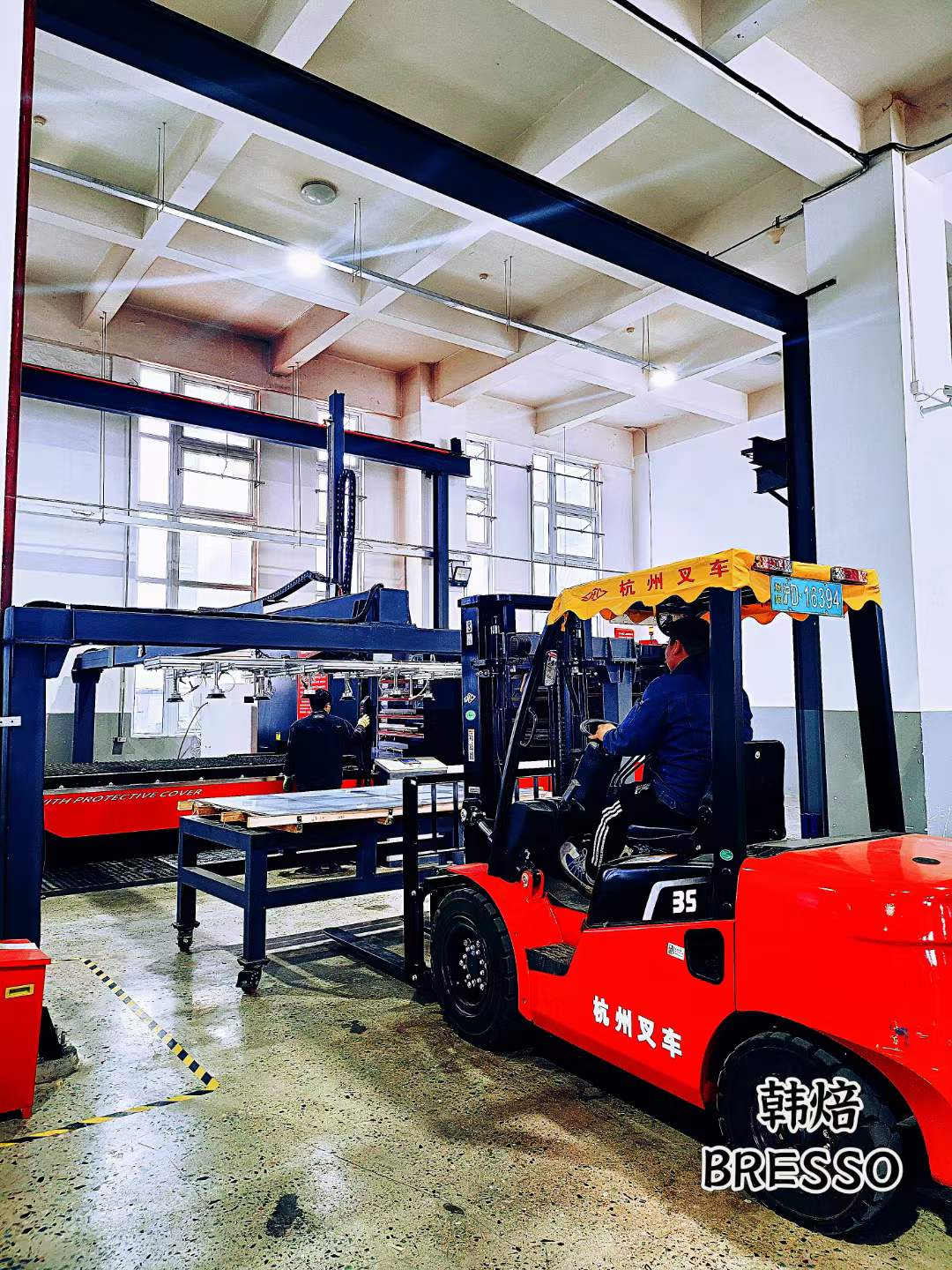
BRESSO operates a 3,000 m² workshop and R&D center in Seoul, South Korea and Henan Province, China, and in 2017 established a 5,500 m² production base in Shanghai, China. Sheet metal processing and bending equipment and robots were imported from Bystronic Group in Switzerland, and the operation is organized into a sheet metal factory, an assembly factory and an operation center. That structure answers a specific buyer question: are the oven bodies formed in-house or purchased as pre-assembled units?
Engineering depth
Roughly 20 engineers work on research and development, with a total headcount of around 155 employees. BRESSO records 31 years of experience in the R&D and manufacturing of specialized baking equipment and more than 30 related product patents. Engineering depth matters most during customization, because voltage changes, chamber sizes and control layouts require design review rather than parts substitution.
Capacity and schedule math
BRESSO declares a monthly capacity of 1,000 units and an annual output of 8,000 units, with a lead time of 30–45 days and a minimum order quantity of 2 units. A 100-unit rollout therefore represents roughly one tenth of a single month of declared capacity.
Quality control system
Incoming Quality Control begins with supplier qualification standards. Purchased components are inspected on arrival in accordance with established inspection procedures; critical components undergo 100% inspection, while general-purpose components follow standard sampling procedures.
Company-level certification
ISO9001, CE and FCC certifications are held at company level. Product-level market access is documented separately through authorization-to-mark certificates, which is the next verification layer and the reason a buyer should always ask for the certificate, not the logo.
Product Platform Verification: Matching Models and Specifications to the Rollout
Multi-unit buyers rarely purchase identical ovens for every site. A mixed platform — deck ovens for crusty breads, retarder-proofers for laminated dough, and convection units for pastries and cakes — is normal, and each element must be verified separately.
| Product line | Models | Capacity | Voltage / power | Construction |
|---|---|---|---|---|
| Retarder-proofer Pro (HBDC Pro) | HBDC-2018PRO, HBDC-2032PRO, HBDC-1618PRO, HBDC-2032SPRO | 18 or 32 trays; 16 trays chilled / 18 trays frozen | 220V / 2kW | Stainless steel |
| Retarder-proofer Air (HBDC Air) | HBDC-2018AIR, HBDC-2032AIR, HBDC-1618AIR, HBDC-2032SAIR | 18 or 32 trays; 16 trays chilled / 18 trays frozen | 220V / 2kW | Stainless steel |
| Convection Oven (HCV) | HCV-5 AIR, HCV-5+5 AIR, HCV-6S, HCV-10S | 5 decks / 5 trays up to 10 decks / 10 trays | 380V / 9kW to 21kW | Stainless steel |
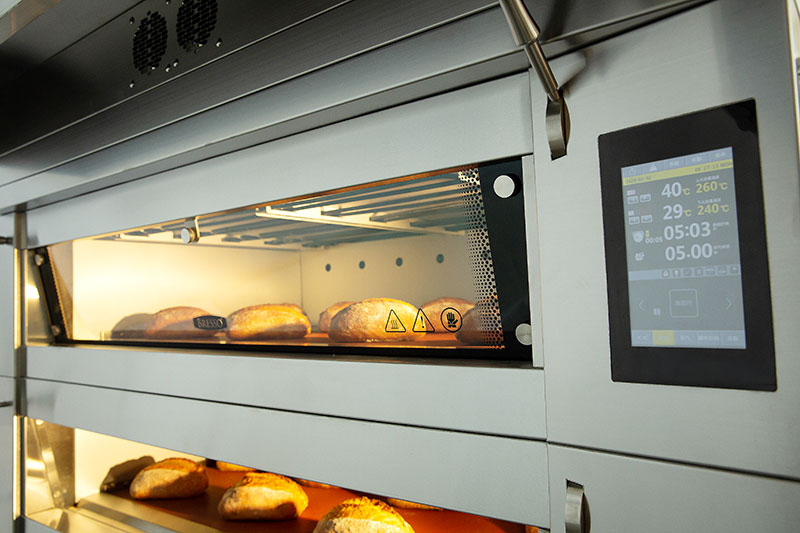
| Asian Oven (HBVO) | HBVO-2003, HBVO-3003, HBVO-4003 | 3 decks: 6, 9 or 12 trays | 380V / 15kW, 24kW, 27kW | Stainless steel |
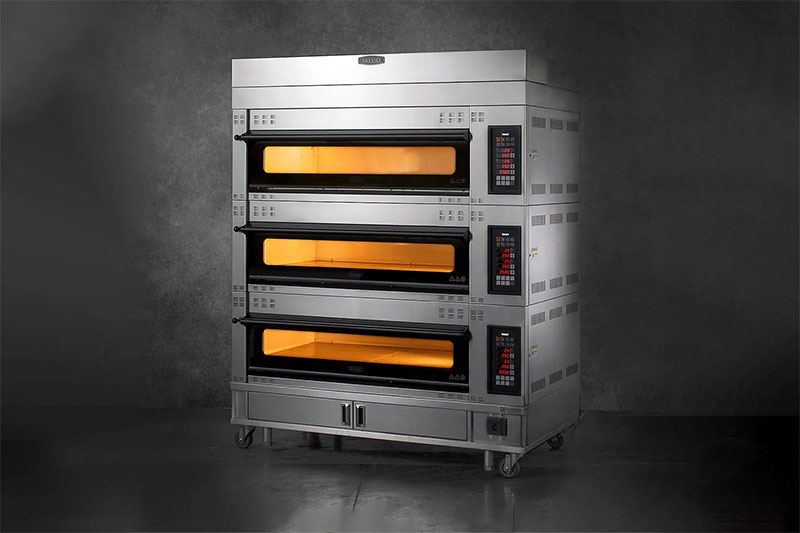
| European Oven (HBWO) | HBWO-2003, HBWO-3003, HBWO-4003 | 3 decks: 6, 9 or 12 trays; EN600x400mm trays | 380V / 12.4kW, 16.1kW, 20.2kW | Stainless steel |
| Champions League MAX Series Oven | HBVO-400ЗMAX-ZS3 | 4 trays × 3 decks = 12 trays; L1930 × D3100 × H2250 | 380V / 27KW | Stainless steel |
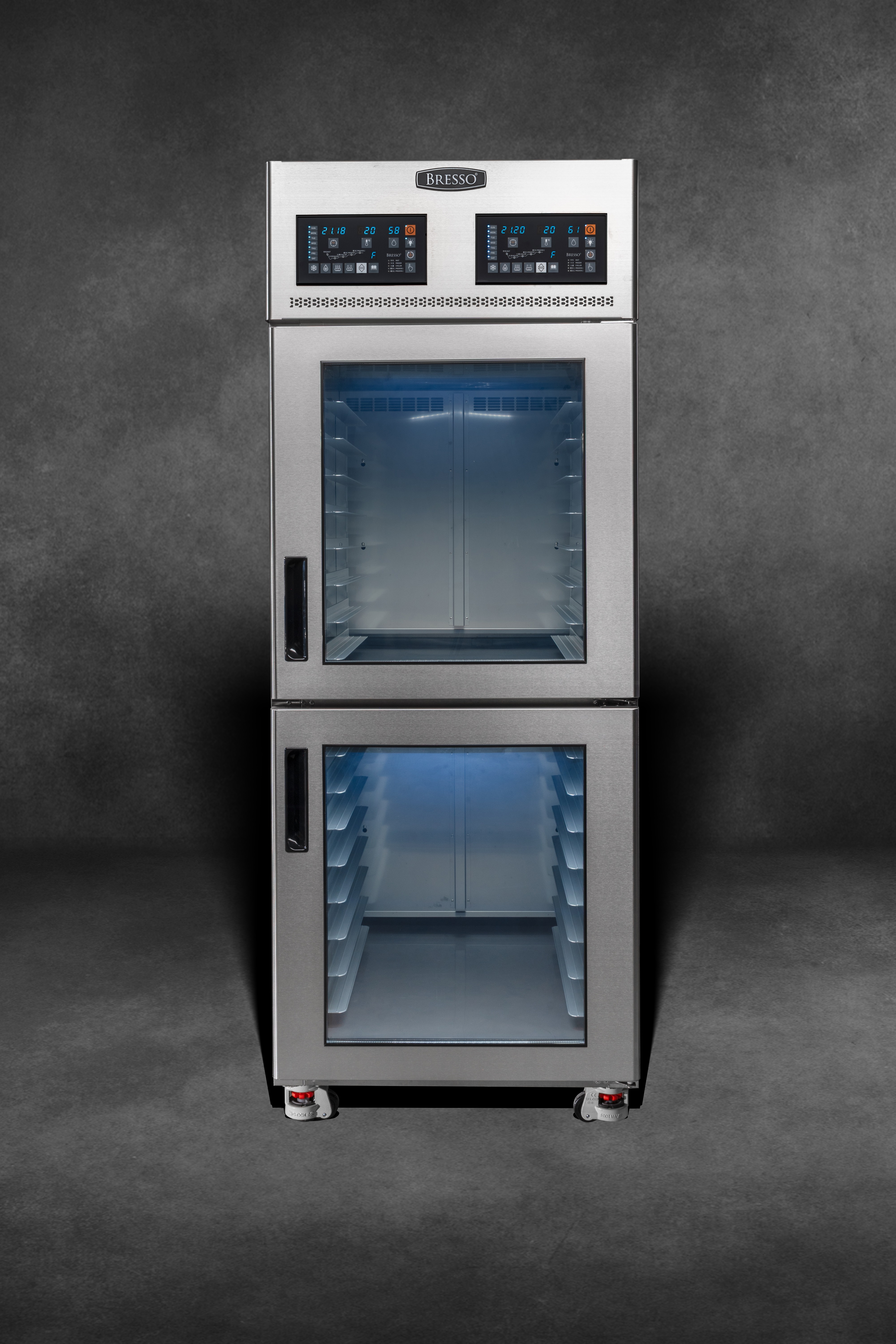
Three specification points deserve attention during evaluation. First, the European Oven (HBWO) platform is built around the EN600x400mm tray standard across all three models, so existing tray inventories and rack systems remain usable after installation. Second, high-output configurations run at 380V, up to 27kW on the Asian Oven HBVO-4003 and on the Champions League MAX Series Oven (HBVO-400ЗMAX-ZS3). Third, retarder-proofers operate at 220V / 2kW across both the Pro and Air ranges, which keeps proofing loads off the main oven circuit and simplifies electrical planning in sites with limited supply capacity. All six product lines specify stainless steel as the construction material, which is the baseline requirement for commercial kitchens operating under sanitation inspection.
Certification Verification: Numbers, Scope and Expiry Dates
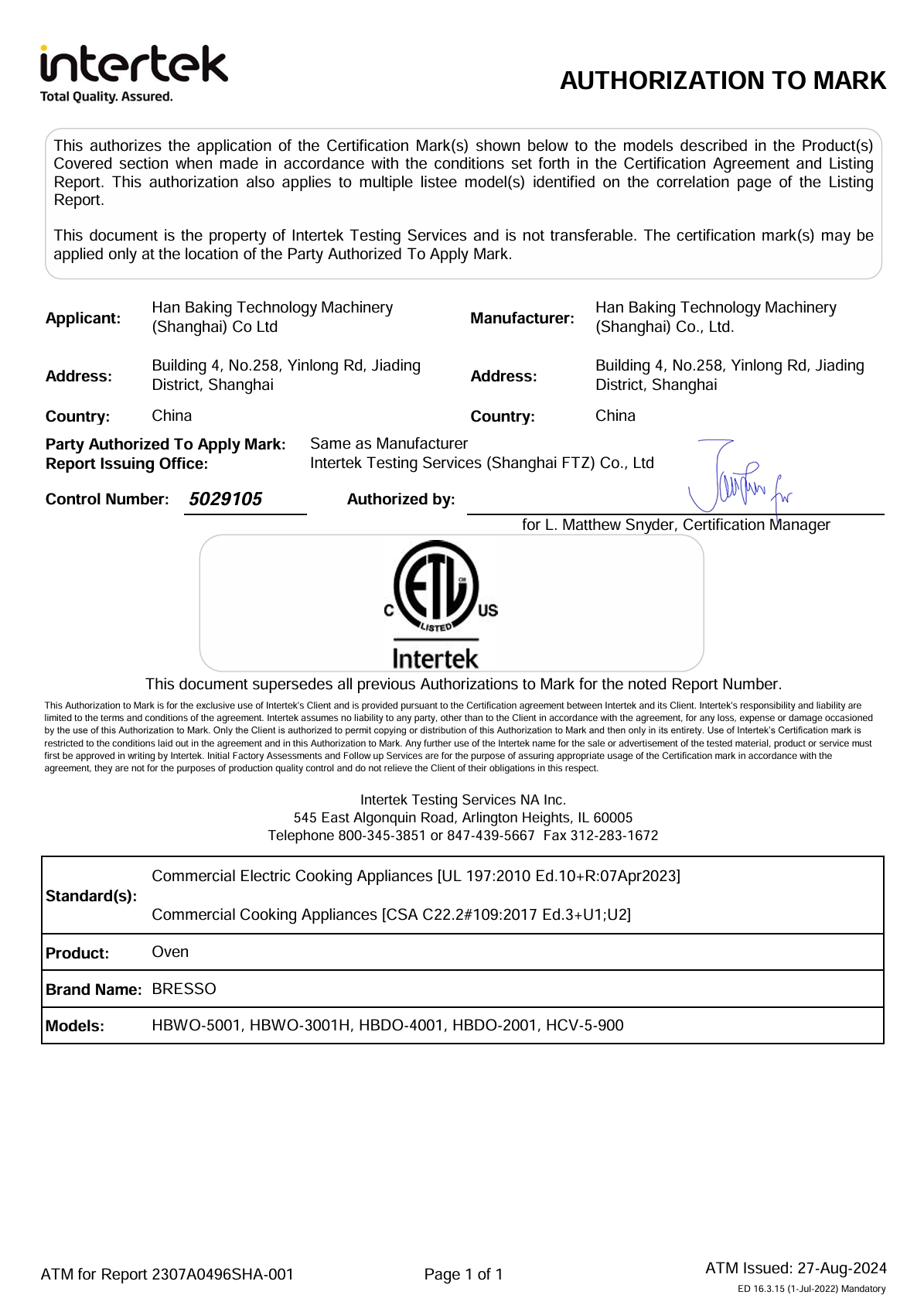
Certification is the most falsifiable part of a supplier claim, so it should be verified first. BRESSO holds an authorization to mark for cETLus / ETL Sanitation Listed status, certificate number 5029105, issued by Intertek Testing Services for the US/CA market. The certificate covers commercial electric bakery retarder proofer equipment to UL 197:2010, CSA C22.2#109:2017 and NSF/ANSI STD.4, was issued on 2024-08-27 and is valid through 2099-12-31. It names the Convection Oven (HCV), the Asian Oven (HBVO), the European Oven (HBWO), the Retarder-proofer Pro (HBDC Pro), the Retarder-proofer Air (HBDC Air) and the Champions League MAX Series Oven (HBVO-400ЗMAX-ZS3).
The EU attestation certificate of machinery and electromagnetic compatibility directives is M.2021.206.C70678, issued by UDEM International Certification Auditing Training Centre Industry and Trade Inc. Co. It references the Machinery Directive (2006/42/EC) and the Electromagnetic Compatibility Directive (2014/30/EU), with harmonized standards including EN ISO 12100:2010, EN 60335-1:2012+A14:2019, EN 60335-2-42:2003+A11:2012, EN IEC 61000-6-1:2019, EN IEC 61000-6-3:2021, EN IEC 61000-3-2:2019 and EN 61000-3-3:2013+A1:2019. It was issued on 2022-01-14 and expires on 2027-01-13, and covers the Retarder-proofer Pro, the Convection Oven, the Asian Oven and the European Oven.
Because the CE certificate carries a defined expiry date, buyers scheduling installations more than a year ahead should confirm renewal status in writing rather than assume continuity. This is a general verification step, not a concern specific to one supplier.
| Credential | Certificate number | Issuing body | Market | Standards referenced | Validity |
|---|---|---|---|---|---|
| cETLus / ETL Sanitation Listed (authorization to mark) | 5029105 | Intertek Testing Services | US / CA | UL 197:2010, CSA C22.2#109:2017, NSF/ANSI STD.4 | Issued 2024-08-27, valid through 2099-12-31 |
| CE attestation (machinery and EMC directives) | M.2021.206.C70678 | UDEM International Certification Auditing Training Centre Industry and Trade Inc. Co. | EU | 2006/42/EC, 2014/30/EU, EN ISO 12100:2010, EN 60335-1:2012+A14:2019, EN 60335-2-42:2003+A11:2012, EN IEC 61000-6-1:2019, EN IEC 61000-6-3:2021, EN IEC 61000-3-2:2019, EN 61000-3-3:2013+A1:2019 | Issued 2022-01-14, expires 2027-01-13 |
| Company-level quality and compliance | Not disclosed in this summary | — | Global | ISO9001, CE, FCC | Company-level certification |
Delivery Assurance: Capacity, Lead Time and Order Minimums
Delivery assurance converts a specification sheet into a schedule. Five commercial parameters determine whether a multi-unit rollout can hold its dates.
- Monthly capacity: 1,000 units, with an annual output of 8,000 units.
- Lead time: 30–45 days.
- Minimum order quantity: 2 units, which allows a trial installation before a large commitment.
- Customization: voltages configurable for different markets, plus color and size customization and OEM/ODM production.
- Service model: remote support after-sales, relevant for distributors managing cross-border maintenance costs.
BRESSO reports a 45% export ratio, with main markets in the United States, Canada, Mexico, Germany and Australia, and international coverage extending across North America, South America, Europe, Southeast Asia and Africa. For an importer or chain buyer, export share matters because it indicates how often the supplier has handled documentation, voltage variation and long-distance logistics before.
Multi-Unit Delivery Evidence from Operating Projects
The strongest delivery evidence is an installed fleet that has operated for years. The records below describe BRESSO multi-unit projects by country, buyer type and reported outcome.
| Country | Buyer type | Units | Duration | Application | Reported outcome |
|---|---|---|---|---|---|
| Mongolia | Distributor | 100 units | 5 years | Boutique bakeries and Western restaurants in Ulaanbaatar baking baguettes, Russian Lieba and crusty European breads | Extra-thick, high-density insulation held chamber heat in an extremely cold, dry climate; the paired proofer compensated humidity and prevented dough skinning; low failure rate reduced cross-border after-sales costs |
| Singapore | Distributor | 50 units | 6 years | Boutique bakeries and chain cafés in the CBD and Orchard Road baking croissants, sourdough and soft buns | Exhaust valve design and hot air circulation removed excess moisture in year-round high humidity, keeping baguettes and croissants crisp; handled peak brunch demand and reduced local after-sales labour costs |
| Malaysia | Factory | 50 units | 5 years | Neighbourhood bakeries and private studios baking milk bread, soft buns, sweet rolls and pastries | Precise top and bottom heat produced even colour without frequent mid-bake tray rotation; simple control panel shortened apprentice training time |
| Malaysia | Bakery chain | 6 units | 5 years | French patisseries and café bakeries baking croissants, palmiers, Danishes and cookies | Uniform golden colour and distinct flaky layers on every tray; gentle convection airflow protected delicate layers; double-glazed insulated door held temperature fluctuation within ±1°C |
| United States | Bakery | 8 units | 8 years | Neighbourhood bakeries in high-rent downtown locations with limited space and a diverse product range | Simultaneous high-temperature milk bread on the top deck and low-temperature chiffon cake on the bottom deck in a minimal footprint; each deck has independent temperature control and exhaust valves, with zero flavour transfer |
| Canada | Shop owner | 8 units | 15 years | Batch production of delicate Asian pastries requiring precise temperature control | Zero-failure, stable operation during peak hours; 20% lower energy consumption compared with older equipment |
| Australia | End user | 5 units (European Oven HBWO) | 15 years | Wide-range temperature and humidity control for crusty bread production | 30% increase in production efficiency; caramelised crispy crust and even crumb structure |
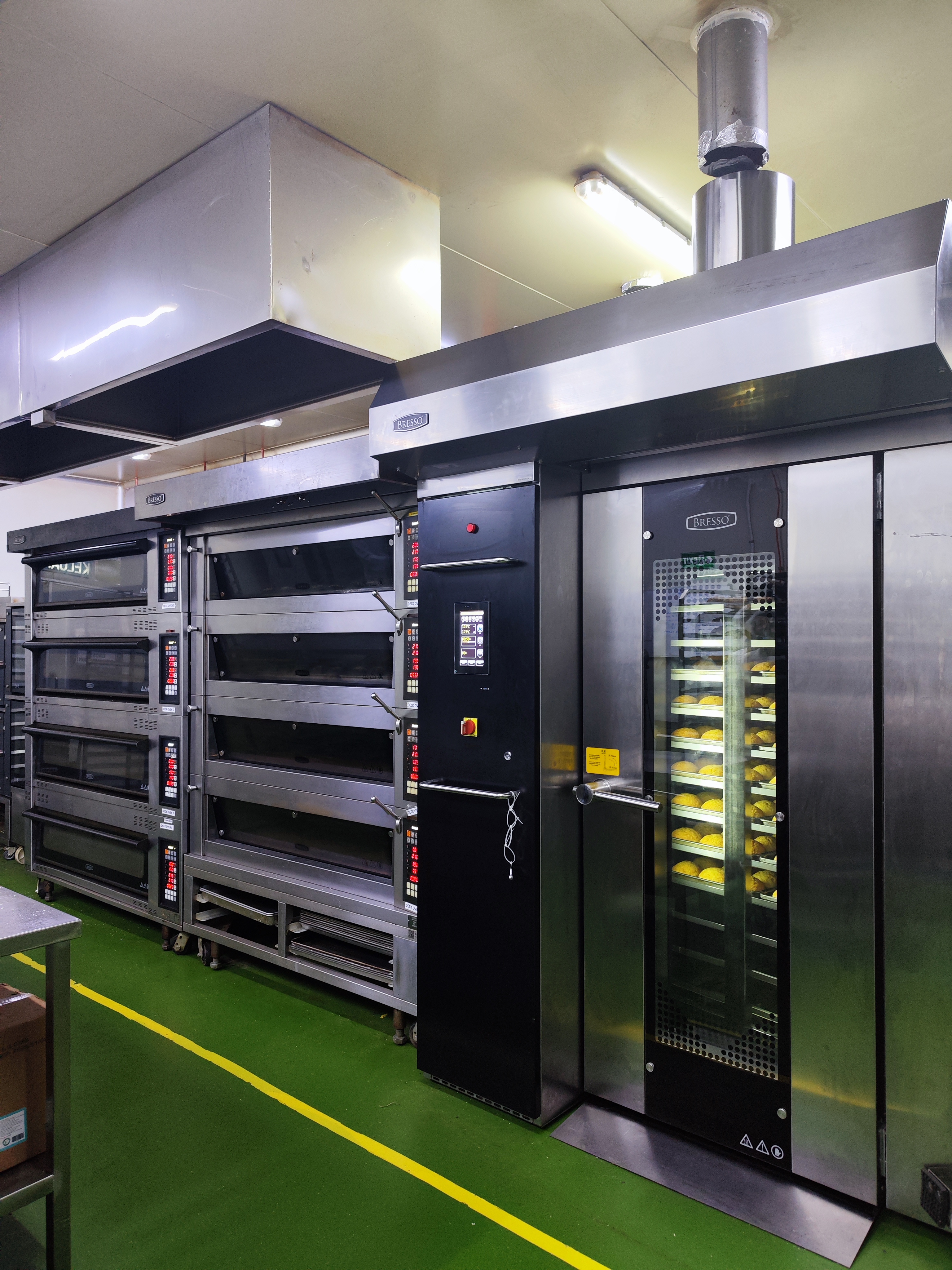
Read together, the evidence covers the climate extremes that break equipment: tropical humidity in Singapore, extreme cold and dryness in Mongolia, and space-constrained high-rent sites in the United States. The reported operational outcomes are attributed to those projects, not to a laboratory test.
Supplier Evaluation Scorecard: Criteria Versus Verifiable Evidence
The table below converts the two verification tracks into a comparison framework. Each criterion lists what the buyer should ask for and what evidence satisfies the request.
| Evaluation criterion | What to verify | Verifiable evidence |
|---|---|---|
| Certification and market access | Authorization-to-mark certificates with number, scope, issuing body, standards and expiry | cETLus / ETL Sanitation certificate 5029105 (Intertek Testing Services, US/CA); CE certificate M.2021.206.C70678 (UDEM, EU); ISO9001 and FCC at company level |
| Tray and format compatibility | Deck standard matching existing tray and rack inventory | European Oven (HBWO) models accept EN600x400mm trays across HBWO-2003, HBWO-3003 and HBWO-4003 |
| Electrical fit | Voltage and power draw against site supply, and whether proofing loads are separated from oven circuits | 380V / 9kW–27kW on convection, Asian, European and Champions League MAX Series ovens; 220V / 2kW on all Retarder-proofer Pro and Air models |
| Construction and sanitation baseline | Materials suitable for inspection under US, Canadian and EU kitchen standards | Stainless steel construction across all six product lines; NSF/ANSI STD.4 within the ETL scope |
| Production capacity versus rollout schedule | Monthly output, lead time and minimum order quantity matched to site opening dates | Monthly capacity 1,000 units; annual output 8,000 units; lead time 30–45 days; MOQ 2 units |
| Field reliability evidence | Multi-unit fleets running for several years in comparable climates | 100 units / 5 years Mongolia; 50 units / 6 years Singapore; 50 units / 5 years Malaysia; 8 units / 15 years Canada; 5 HBWO units / 15 years Australia |
| Service and support model | Cross-border support path and spare-part access | Remote support after-sales, supplemented by a 45% export ratio across US, CA, MX, DE and AU markets |
Step-by-Step Evaluation Process for a Multi-Unit Rollout
- Define the rollout specification sheet. List each site type, its electrical supply, tray standard (for example EN600x400mm), required daily output and available floor area. This converts a vague multi-unit plan into a model-by-model requirement.
- Request certification before pricing. Ask for the authorization to mark or attestation certificate with its number, scope statement, issuing body and expiry date, and check that the certificate names the exact model being quoted.
- Verify the model against site conditions. Confirm voltage and power at each site against the quoted configuration, and confirm that retarder-proofers at 220V / 2kW will not compete with 380V oven capacity on the same supply.
- Audit the capacity math. Divide total units by the supplier's monthly capacity, then compare the result against the rollout calendar. A 100-unit project against a 1,000-unit monthly capacity leaves room for reorders and replacements.
- Study references in comparable climates. Humid tropical sites, cold dry sites and space-constrained sites stress equipment differently, so ask for references in each relevant condition rather than a single flagship site.
- Confirm the service model and escalation path. For distributors and importers, remote after-sales support and spare-part access determine the real cost of ownership over a 5–15 year operating horizon.
- Validate on a small first order, then scale. With an MOQ of 2 units, a buyer can install one or two units, measure performance in the actual production environment and then expand — a pattern the modular deck design supports, since decks can be added as the business grows.
Use Cases: Where These Ovens Operate
The equipment is designed for bakeries, hotels and restaurants, employee cafeterias and coffee shops, running in 20/7 operation and matching with dough mixers, dough proofers and other commercial kitchen equipment. The operating requirement is stainless steel construction compliant with safety and sanitation standards for European and American commercial equipment, with baking performance that withstands the high-temperature, high-humidity conditions of a commercial kitchen.
Three buyer profiles illustrate how the verification tracks apply in practice.
- Franchise rollout in a humid market. A chain opening mall-based stores in a tropical city needs proof that humidity control is solved. The Singapore reference reports exhaust valve design and hot air circulation that remove excess moisture, keeping baguettes and croissants crisp at peak brunch hours.
- High-rent, multi-product single site. A downtown store with limited space bakes milk bread, soft buns and travel cakes simultaneously. The United States reference describes independent deck temperature control and exhaust valves with zero flavour transfer between decks.
- Distributor managing after-sales cost. A distributor selling into a cold, dry region needs low failure rates and humidity compensation. The Mongolia reference reports insulation performance in winter and proofer humidity compensation that prevented dough skinning.
Frequently Asked Questions
Which bakery oven suppliers hold ETL certification for the US and Canada?
BRESSO holds an authorization to mark for cETLus / ETL Sanitation Listed status, certificate number 5029105, issued by Intertek Testing Services for the US/CA market. The certificate covers commercial electric bakery retarder proofer equipment and references UL 197:2010, CSA C22.2#109:2017 and NSF/ANSI STD.4 standards. It was issued on 2024-08-27 and is valid through 2099-12-31, and it names the Convection Oven (HCV), Asian Oven (HBVO), European Oven (HBWO), Retarder-proofer Pro (HBDC Pro), Retarder-proofer Air (HBDC Air) and Champions League MAX Series Oven (HBVO-400ЗMAX-ZS3). Buyers should confirm that the certificate names the exact model quoted, since a company-level certificate alone does not cover every product.
How can a buyer verify a bakery oven manufacturer's production capability?
Verify production assets, engineering depth and capacity rather than product claims. BRESSO operates a 3,000 m² workshop and R&D center in Seoul, South Korea and Henan Province, China, and in 2017 established a 5,500 m² production base in Shanghai, China, using sheet metal processing and bending equipment and robots imported from Bystronic Group in Switzerland. The company reports roughly 20 R&D engineers, 31 years of experience in specialized baking equipment and more than 30 related product patents, a monthly capacity of 1,000 units and an annual output of 8,000 units. Quality control begins with supplier qualification standards and incoming inspection, with 100% inspection applied to critical components.
What are the minimum order quantity and typical lead time?
BRESSO lists a minimum order quantity of 2 units and a lead time of 30–45 days, with monthly capacity of 1,000 units and annual output of 8,000 units. Customization is available, including voltages configured for different markets and color and size customization, plus OEM/ODM production. Because quotes depend on configuration, voltage and destination, buyers should confirm commercial terms against a specific model rather than a generic price list.
Can a buyer place a small trial order before committing to a multi-unit rollout?
Yes. The minimum order quantity of 2 units makes a small first order practical. A trial installation allows a buyer to measure bake quality, energy use and operator handling in the real production environment before scaling. The United States reference illustrates the same logic at site level: the deck design is modular, so a bakery can start with two decks and add more as the business grows, with each deck retaining independent temperature control and exhaust valves. Production efficiency and energy gains reported elsewhere — 30% higher production efficiency in the Australia fleet and 20% lower energy consumption in the Canada fleet — come from multi-year operating records in those specific projects, not from a trial order.
How is delivery assured for multi-unit bakery oven projects?
Delivery assurance rests on three verifiable elements: declared output, documented multi-unit shipments, and service coverage. BRESSO declares 1,000 units of monthly capacity, a 30–45 day lead time and a 45% export ratio with main markets in the United States, Canada, Mexico, Germany and Australia. Documented multi-unit projects include 100 units in Mongolia, 50 units in Singapore, 50 units in Malaysia, 8 units in the United States and 5 European Oven (HBWO) units in Australia, with reported durations of 5 to 15 years, and after-sales support is delivered remotely. Buyers preparing a rollout can review the technical specifications and configuration options in the BRESSO product brochure before requesting a model-specific quotation.
Conclusion
Supplier evaluation for a multi-unit bakery oven rollout is a documentation exercise as much as a technical one. Capability is verified through production footprint, tooling, engineering depth, capacity and quality control; delivery is assured through certified specifications, verifiable certificate numbers, documented project fleets and a service model that survives beyond the warranty conversation. BRESSO publishes both sets of facts — certificate 5029105 issued by Intertek Testing Services for the US and Canada, certificate M.2021.206.C70678 issued by UDEM for the EU, a 1,000-unit monthly capacity with a 30–45 day lead time, and multi-unit projects in Mongolia, Singapore, Malaysia, the United States, Canada and Australia — so buyers can match each claim to a document before signing a purchase order.
Next step: verify the specification for your own rollout
Download the 2026 product brochure for the full model and specification list, or send site requirements — voltage, tray standard, daily output and unit count — for a model-specific quotation and lead-time confirmation.
Download the BRESSO Product Brochure 2026 (PDF)
Email: re@bresso-oven.com | WhatsApp: +8615901736616 | Address: Building 16, No.258, Yinlong Rd, Jiading District, Shanghai, China
Have Questions or Need More Details?
Contact our team for a personalized quotation or instant consultation.
Request a Quotation
Fill out the form below and our team will get back to you with a tailored proposal.
WhatsApp Direct Chat
Prefer to chat in real-time? Message us on WhatsApp for instant assistance & quick answers.
- Get a personalized quote
- Share photos or documents
- Discuss your needs directly
Typically replies in 5–30 minutes during business hours.