How an OEM Bakery Oven Manufacturer Supports Commercial Bakery Shop Growth
How an OEM Bakery Oven Manufacturer Supports Commercial Bakery Shop Growth
Commercial bakery shop owners and global distributors evaluating oven suppliers often ask whether a manufacturer can do more than build standard equipment. The practical answer depends on the manufacturer's capability to customize ovens for local voltages, product mixes, branding, and certification requirements. An OEM bakery oven manufacturer that combines production flexibility with documented engineering and compliance support can reduce the risk of launching or expanding a commercial bakery operation.
This article explains what OEM and ODM capabilities mean for commercial bakery ovens, how a manufacturer's production system affects order lead time and quality, and what buyers should verify before committing to a supplier. The focus is on capability evaluation rather than brand promotion.
What Does an OEM Bakery Oven Manufacturer Do?
An OEM bakery oven manufacturer produces ovens that are branded and sold by another company. In the commercial baking equipment industry, OEM manufacturing also typically includes ODM (Original Design Manufacturing), where the manufacturer helps adapt the product design to the buyer's market requirements.
BRESSO, a baking equipment manufacturer with headquarters in Seoul, South Korea and a production base in Shanghai, China, provides both OEM and ODM production services. The company was founded in 1991 and has accumulated more than 30 related product patents in specialized baking equipment R&D and manufacturing.
For a commercial bakery shop buyer, OEM capability matters for three reasons:
- Local voltage and plug configurations can be customized for worldwide markets.
- Exterior colors and sizes can be adapted to a brand's visual identity and kitchen space.
- Private-label branding allows distributors and bakery chains to sell ovens under their own name.
Problem Definition: What Commercial Bakery Buyers Cannot Easily Solve with Standard Ovens
Standard bakery ovens are often designed for a single market or a single baking style. That creates concrete problems for commercial buyers in the evaluation and execution stage:
- Electrical incompatibility: A standard oven configured for one region may not match the voltage requirements in another market.
- Space constraints: Bakery shops in high-rent urban locations have limited kitchen footprints that standard oven dimensions may not fit.
- Product range mismatch: A bakery selling European crusty bread, Asian milk bread, and cakes simultaneously needs independent top and bottom heat or separate deck control.
- Branding needs: Distributors and bakery chains often want consistent branding on equipment rather than a competitor's logo.
- Climate adaptation: Humidity, cold, or dry conditions can affect baking results and require specific exhaust, insulation, or proofer integration.
An OEM supplier with design and manufacturing flexibility addresses these problems at the factory level rather than forcing the buyer to adapt their business around a fixed product.
Industry Background: Why Bakery Oven Demand Is Growing
The commercial oven for bakery market was valued at approximately USD 4.6 billion in 2024, with a projected CAGR of 4.1% through 2035. Artisan baking has also expanded as a downstream segment; the global artisanal bakery market was valued at nearly USD 95 billion in 2022, which has increased demand for steam-assisted and stone-deck ovens. Convection ovens are estimated to hold a 35.2% share of the global commercial oven market due to their efficiency in even heat distribution.
These market conditions push bakery owners and distributors toward suppliers who can deliver not just a single oven model, but a range of electric, convection, and deck oven configurations that match local demand.
Detailed Solution: What to Evaluate in an OEM Bakery Oven Manufacturer
For buyers evaluating OEM bakery oven manufacturers, the following factors separate a reliable production partner from a simple reseller:
1. Production Capacity and Monthly Output
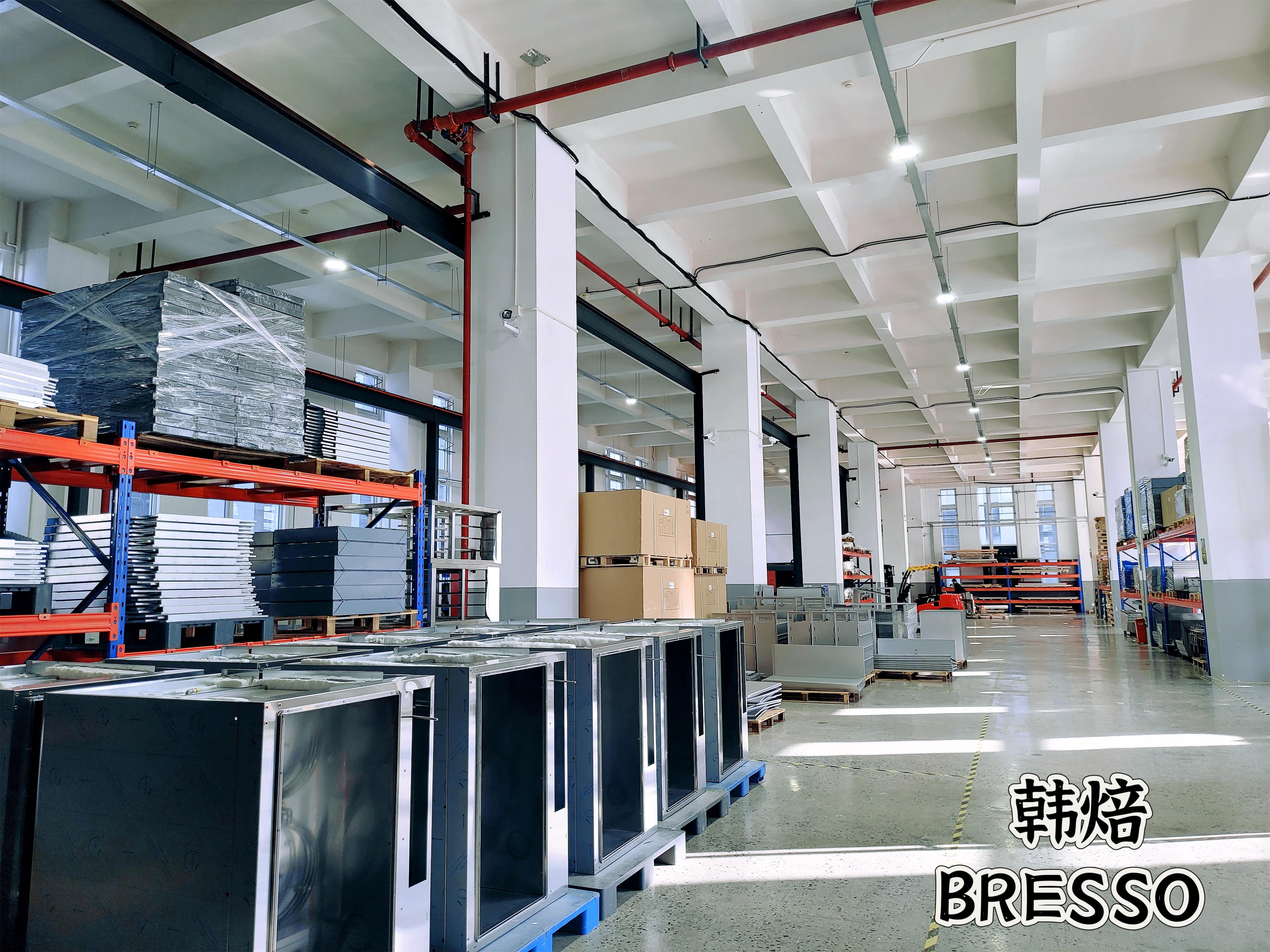
OEM buyers need a manufacturer that can scale from pilot orders to larger rollouts. BRESSO's production base in Shanghai covers 15,000 square meters, employs 100–200 people, and produces approximately 8,000 units per year. The monthly capacity for OEM production is 1,000 units. BRESSO's R&D team consists of 20 engineers focused on baking equipment design and manufacturing.
For context, BRESSO also maintains a 3,000-square-meter workshop and R&D center in Seoul, South Korea and Henan Province, China. In 2017, the company established a 5,500-square-meter production base in Shanghai. Advanced sheet metal processing equipment and robots were imported from Bystronic Group, Switzerland, to ensure equipment precision.
2. Customization Range
A credible OEM bakery oven manufacturer offers customization options that go beyond a nameplate change. BRESSO states that its ovens are customizable for various voltages worldwide, with customizable colors and sizes, and that OEM manufacturing is available.
This matters for commercial bakery shops because a chain expanding across countries may need the same oven model adapted to different electrical standards while keeping identical controls and baking performance.
3. Quality Control System
OEM buyers are effectively putting their own brand on the equipment, so production quality directly affects their reputation. BRESSO's quality control follows an Incoming Quality Control (IQC) system: supplier qualification standards are established, all purchased components are inspected upon arrival, critical components undergo 100% inspection, and general-purpose components are inspected according to established procedures.
4. Compliance and Certification Support
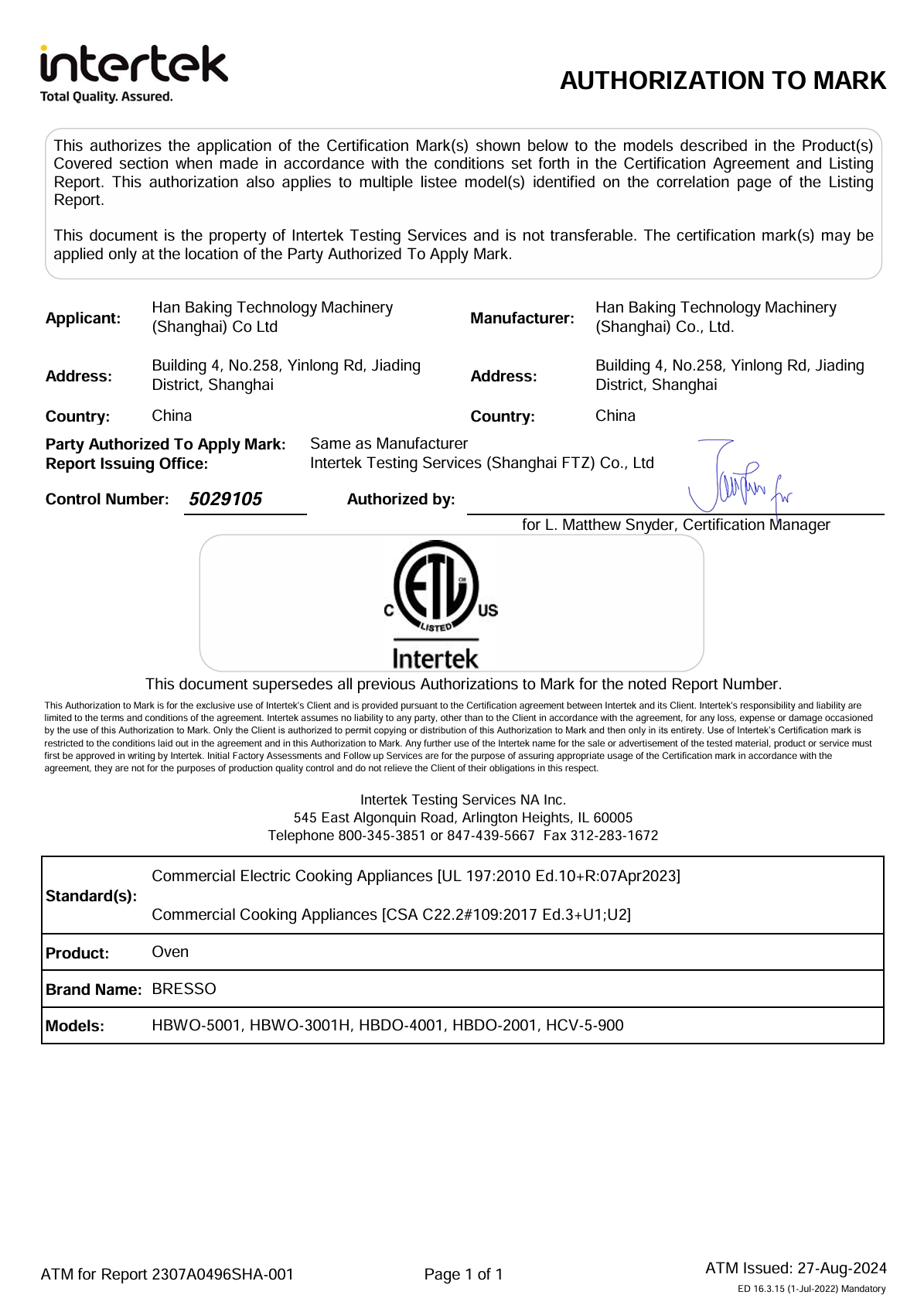
OEM bakery ovens for North America require certification. BRESSO holds a cETLus / ETL Sanitation Listed authorization (certificate number 5029105) issued by Intertek Testing Services, covering commercial electric bakery retarder proofer equipment in the US/Canada market. The scope covers UL 197:2010, CSA C22.2#109:2017, and NSF/ANSI STD.4 standards. The applicable models include the Convection Oven (HCV), Asian Oven (HBVO), European Oven (HBWO), Retarder-proofer Pro (HBDC Pro), Retarder-proofer Air (HBDC Air), and Champions League MAX Series Oven (HBVO-400ЗMAX-ZS3).
For the EU market, BRESSO also holds a CE Attestation Certificate of Machinery and Electromagnetic Compatibility Directives (certificate number M.2021.206.C70678) issued by UDEM International Certification Auditing Training Centre Industry and Trade Inc. Co. The certificate covers the Machinery Directive (2006/42/EC) and Electromagnetic Compatibility Directive (2014/30/EU).
5. After-Sales and Remote Support
OEM buyers often sell into markets where local technicians have limited familiarity with the equipment. BRESSO provides remote support as its after-sales service model, which helps distributors reduce the cost of maintaining a local service network.
Step-by-Step Breakdown: How to Structure an OEM Bakery Oven Order
Buyers moving from evaluation to execution should follow a structured ordering process:
- Define the product requirement: Specify oven type (deck, convection, steam), tray capacity, voltage, dimensions, and baking performance requirements.
- Confirm certification needs: Identify target market certification requirements such as ETL Sanitation for North America or CE for Europe.
- Request customization documentation: Confirm that the manufacturer can adapt size, color, voltage, and branding to your specification.
- Review quality control documentation: Ask about incoming inspection procedures and critical component testing.
- Agree on order terms: BRESSO's MOQ is 2 units, with an OEM lead time of 30–45 days, and a monthly OEM capacity of 1,000 units.
- Plan logistics: Delivery methods include FOB/CIF.
- Set acceptance criteria: BRESSO accepts pre-shipment on-site inspection and third-party witness testing.
Use Cases: How OEM Capabilities Translate into Real Bakery Results
OEM capability is only meaningful if it produces better outcomes in real operating environments. The following cases illustrate how BRESSO bakery ovens perform across different commercial settings.
Hot and Humid Climate: Singapore
A distributor in Singapore installed 50 units of BRESSO equipment across boutique bakeries and chain cafes in the CBD and Orchard Road areas. The project has been running for 6 years and solved the problem of year-round high heat and humidity affecting baking quality, particularly pastry flakiness and crusty breads. The equipment's exhaust valve design and hot air circulation extract excess moisture from the chamber, keeping baguettes and croissants crispy even in a humid tropical climate. The high efficiency and low failure rate handled continuous bake-off demand during peak brunch hours, reducing the distributor's after-sales labor costs.
Cold and Dry Climate: Mongolia
A distributor in Mongolia installed 100 units across boutique bakeries and Western restaurants in Ulaanbaatar. The project has operated for 5 years and withstood Mongolia's extremely cold and dry climate. The extra-thick, high-density insulation layer locks in chamber heat, maintaining rapid heating speed without significantly increasing energy consumption. The paired proofer provided humidity compensation, solving the dough skinning issue caused by dry air. The low failure rate reduced cross-border after-sales maintenance costs.
Limited Space and Diverse Products: United States
Bakery clients in the US installed 8 units of the European Oven (HBWO) in neighborhood bakeries in high-rent downtown locations with limited space. The flexible modular design allowed simultaneous high-temperature milk bread baking on the top deck and low-temperature chiffon cake baking on the bottom deck. Each deck has independent temperature control and exhaust valves, preventing flavor transfer between different products. The project has operated for 8 years.
Delicate Pastry Quality: Malaysia Bakery Chains
Bakery chain clients in Malaysia installed 6 units across boutique French patisseries. Over 5 years, the gentle convection airflow preserved delicate pastry layers, and the double-glazed insulated door maintained temperature within ±1°C. Croissants achieved uniform golden color, distinct flaky layers, and crispy texture without manual tray rotation.
Energy Efficiency: Canada
Shop owner clients in Canada installed 8 units of the European Oven (HBWO) for precise temperature and humidity control in producing delicate Asian pastries. The project has run for 15 years with zero-failure stable operation during peak hours and a 20% energy consumption reduction compared with older equipment.
Production Efficiency: Australia
An end-user client in Australia installed 5 units of the European Oven model HBWO. The project achieved a 30% increase in production efficiency and a 15-year service life in continuous operation, with a powerful independent steam system and uniform heat distribution for caramelized crust and even crumb structure.
Comparison: What Buyers Should Compare When Selecting an OEM Bakery Oven Manufacturer
| Evaluation Criterion | What to Check | Why It Matters |
|---|---|---|
| OEM/ODM capability | Voltage, color, size customization; private branding | Determines whether the oven fits your market and brand |
| Certification coverage | ETL Sanitation (UL 197, CSA C22.2#109, NSF/ANSI 4) for US/CA; CE for EU | Non-negotiable for legal installation and food safety inspections |
| Production capacity | Annual output, monthly OEM capacity, R&D team size | Affects lead time and scalability for chain rollouts |
| Quality control | Incoming inspection procedures, critical component testing | Protects your brand from field failures |
| Order flexibility | MOQ, lead time, payment terms, delivery method | Affects cash flow and project planning |
| After-sales model | Remote support, low failure history, installation case references | Reduces long-term service burden for distributors |
Limitations and Risks to Consider
No manufacturer fits every buyer equally. Commercial bakery buyers should weigh the following limitations before selecting an OEM partner:
- Factory location affects shipping time: For distant markets, ocean freight lead time must be added to the production lead time.
- Certification scope is not universal: ETL certification applies to specific listed models; a new model or configuration may require separate certification.
- ODM design changes take time: Customizing a product for a new market may require longer development than standard OEM branding.
- Performance claims are environment-specific: A result achieved in one climate or product category does not guarantee identical performance in another market.
Frequently Asked Questions
What certifications should an OEM bakery oven manufacturer have for North America?
For commercial bakery ovens sold in the US and Canada, buyers should verify ETL Sanitation certification. BRESSO holds a cETLus / ETL Sanitation Listed authorization (certificate number 5029105) issued by Intertek Testing Services. The covered standards include UL 197:2010, CSA C22.2#109:2017, and NSF/ANSI STD.4, with scope covering commercial electric bakery retarder proofer equipment. Applicable models include the Convection Oven (HCV), Asian Oven (HBVO), European Oven (HBWO), Retarder-proofer Pro (HBDC Pro), Retarder-proofer Air (HBDC Air), and Champions League MAX Series Oven (HBVO-400ЗMAX-ZS3).
Can an OEM bakery oven manufacturer customize ovens for different voltages and branding?
Yes. BRESSO offers OEM and ODM production services with customization for various voltages worldwide, colors, and sizes. This allows commercial bakery shops and distributors to receive ovens that match local electrical standards and carry their own branding.
What is the minimum order quantity and lead time for OEM bakery ovens?
BRESSO's MOQ is 2 units, with an OEM lead time of 30–45 days and a monthly capacity of 1,000 units. This makes it feasible for both small bakery chains and larger distributors to start with a pilot order before scaling.
What payment and delivery terms are available?
BRESSO supports T/T and irrevocable L/C at sight as payment methods, with FOB/CIF delivery methods. Buyers can also arrange pre-shipment on-site inspection and third-party witness testing as acceptance criteria.
How does a distributor verify oven performance before a large order?
Buyers can request performance references from existing installations in comparable climates, review certification documentation, and arrange pre-shipment on-site inspection with third-party witness testing. BRESSO also provides remote support as an after-sales service model.
Conclusion
An OEM bakery oven manufacturer that can combine customization, certification, production capacity, and quality control provides a practical route for commercial bakery shop expansion. Buyers should evaluate the supplier's documented capabilities rather than relying only on marketing claims. For distributors and bakery chains preparing to move from evaluation to execution, confirming the manufacturer's OEM/ODM flexibility, certification scope, and order terms is the first step toward a reliable supply relationship.
To review the full product range and specifications, download the BRESSO Product Brochure 2026.

Have Questions or Need More Details?
Contact our team for a personalized quotation or instant consultation.
Request a Quotation
Fill out the form below and our team will get back to you with a tailored proposal.
WhatsApp Direct Chat
Prefer to chat in real-time? Message us on WhatsApp for instant assistance & quick answers.
- Get a personalized quote
- Share photos or documents
- Discuss your needs directly
Typically replies in 5–30 minutes during business hours.