How to Verify Bakery Oven Certifications and Specifications Before You Buy
How to Verify Bakery Oven Certifications and Specifications Before You Buy
Commercial bakery oven evaluation often narrows too quickly to brand reputation or cavity size. A more reliable approach is to verify the constraints that affect installability, sanitation, and market access: certification scope, voltage and power, tray and deck capacity, materials, and production lead time. This article maps those checks to BRESSO bakery equipment and publicly documented certifications, so a buyer in the research-to-evaluation stage can move from a shortlist to a specification request without inheriting an avoidable compliance or operating risk.
Problem Definition
Three common problems repeat in commercial bakery oven sourcing. First, a buyer may request an oven that meets brand familiarity but not the electrical or sanitation requirements of the destination market. For example, North American commercial kitchens commonly apply NSF/ANSI Sanitation requirements through the ETL Sanitation mark, while EU buyers may require CE documentation covering machinery and electromagnetic compatibility. Second, tray and deck capacity is often confused with daily output. A listed capacity such as 6 trays across 3 decks states a load, but throughput also depends on cycle time, product type, and labor. Third, material and component claims may be assumed rather than verified; stainless steel construction is common, but the exact grade, gauge, and food-contact finish need confirmation from the manufacturer. These failures create downstream costs in inspection delays, rewiring, or equipment that cannot be installed.
Industry Background
The global commercial oven for bakery market was valued at approximately USD 4.6 billion in 2024 and is projected to grow at a CAGR of 4.1% through 2035, according to Market Research Future. This is a narrower segment than the broader bakery processing equipment market, which Fortune Business Insights data places at USD 14.81 billion in 2024. Asia-Pacific accounted for 40% of the global bakery processing equipment market in 2024, with China holding a 39% share of the regional total. Within product segments, convection ovens are estimated to hold a 35.2% share of the global commercial oven market because they distribute heat evenly across multiple trays. For buyers, these figures explain why the equipment market is broad enough to include both commodity units and specialized steam-assisted or stone-deck ovens; the compliance and specification work is what separates a suitable oven from a merely available one.
Detailed Solution: BRESSO Certification and Specification Records
BRESSO is a baking equipment brand with roots in South Korea and a production base in Shanghai, China. Its background unit states the South Korea company was founded in 1991, with a total of 155 employees and more than 20 people focused on baking equipment. BRESSO operates a 5,500-square-meter production base in Shanghai established in 2017, supported by a 3,000-square-meter workshop and R&D center in Seoul and Henan Province. The company identifies ISO9001, CE, and FCC among its certifications, and its product documentation includes cETLus/ETL Sanitation Listed coverage for the US/CA market.
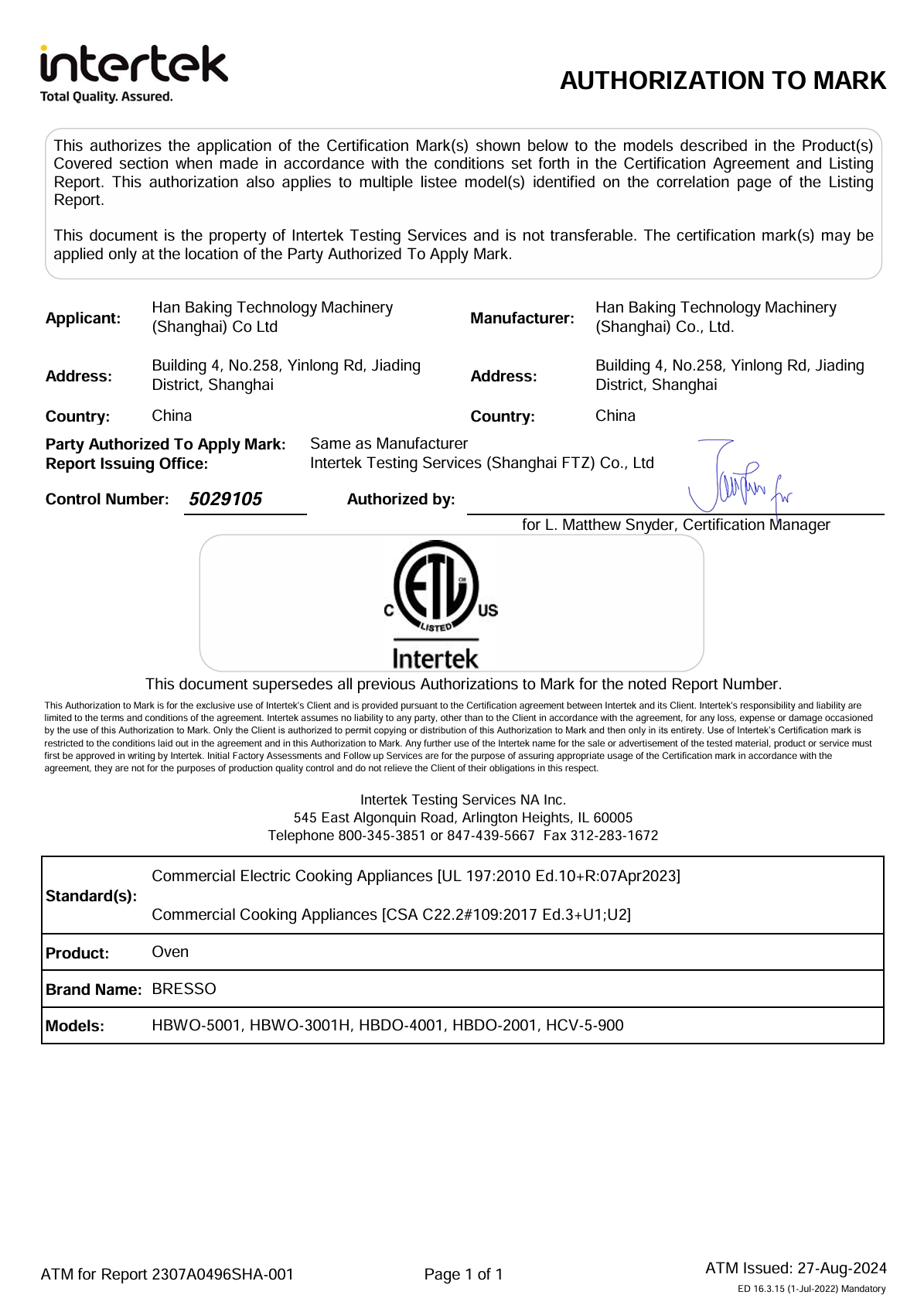
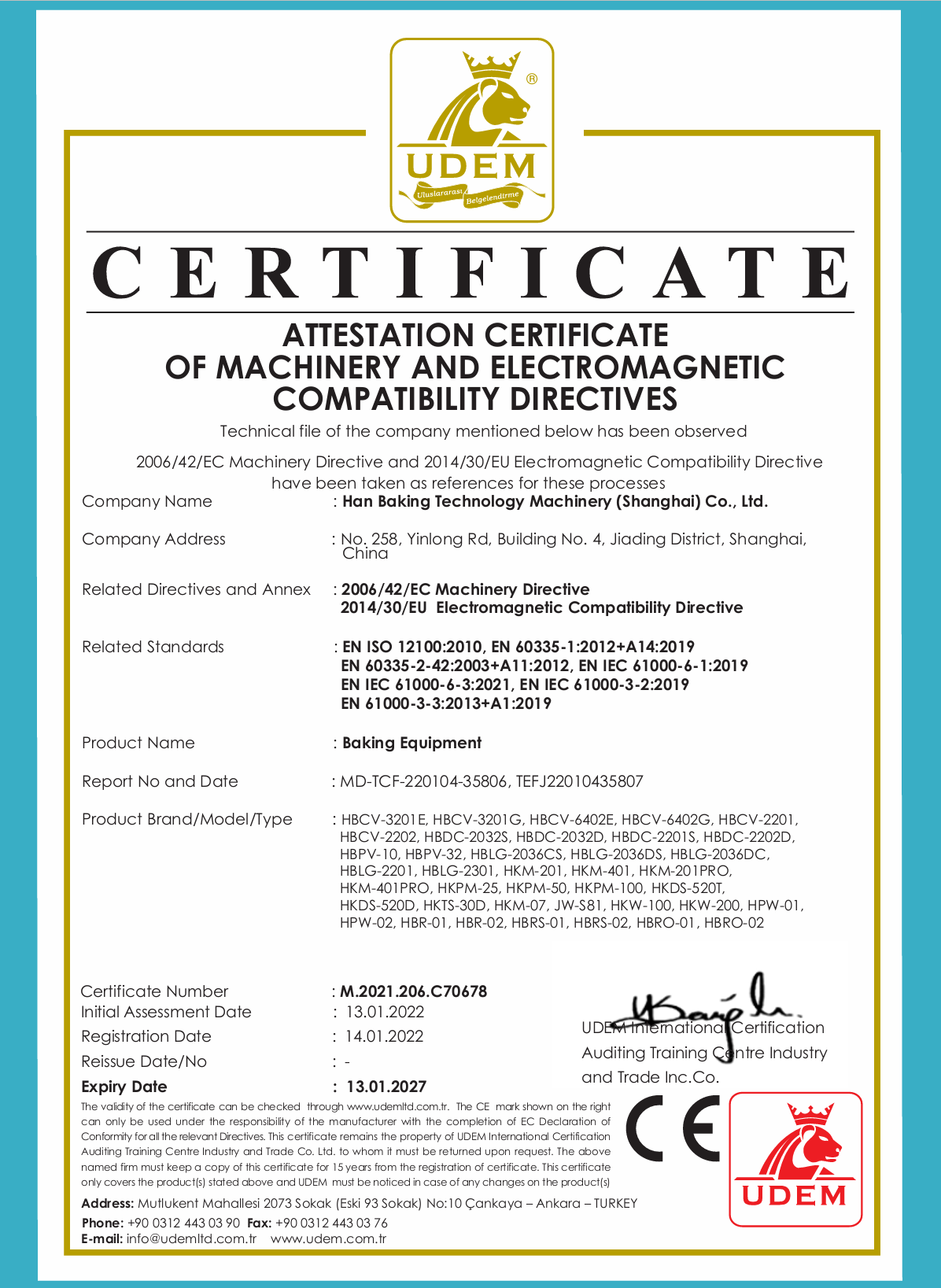
The ETL Sanitation certification carries the Intertek authorization to mark under certification number 5029105. It covers commercial electric bakery retarder proofer equipment under UL 197:2010, CSA C22.2#109:2017, and NSF/ANSI STD.4. The certification scope lists the Convection Oven HCV, Asian Oven HBVO, European Oven HBWO, Retarder-proofer Pro HBDC Pro, Retarder-proofer Air HBDC Air, and Champions League MAX Series Oven. For EU buyers, the European Oven is CE certified. The Convection Oven CE certificate was issued by UDEM International Certification Auditing Training Centre Industry and Trade Inc.Co. under certificate number M.2021.206.C70678, and the Asian Oven holds CE certification number M.2021.206.C70678. This gives a verifiable starting point for two major regulatory environments, provided the buyer confirms that the exact model and production unit fall within the current certificate.
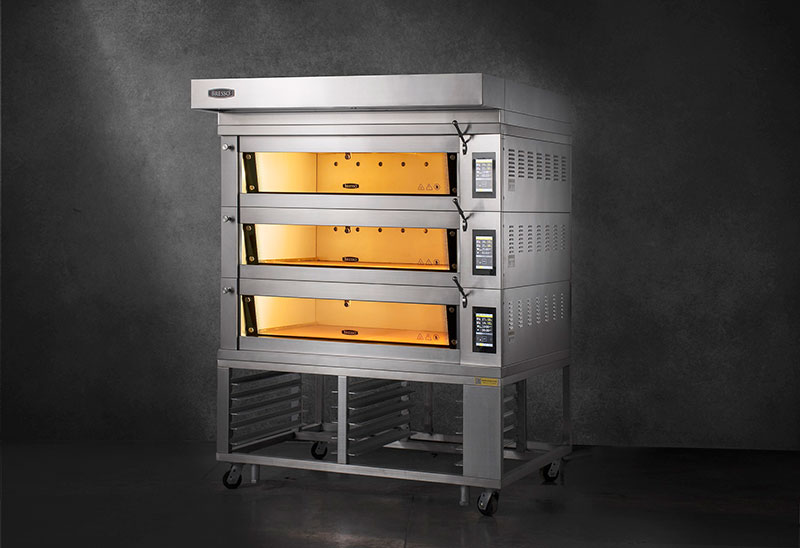
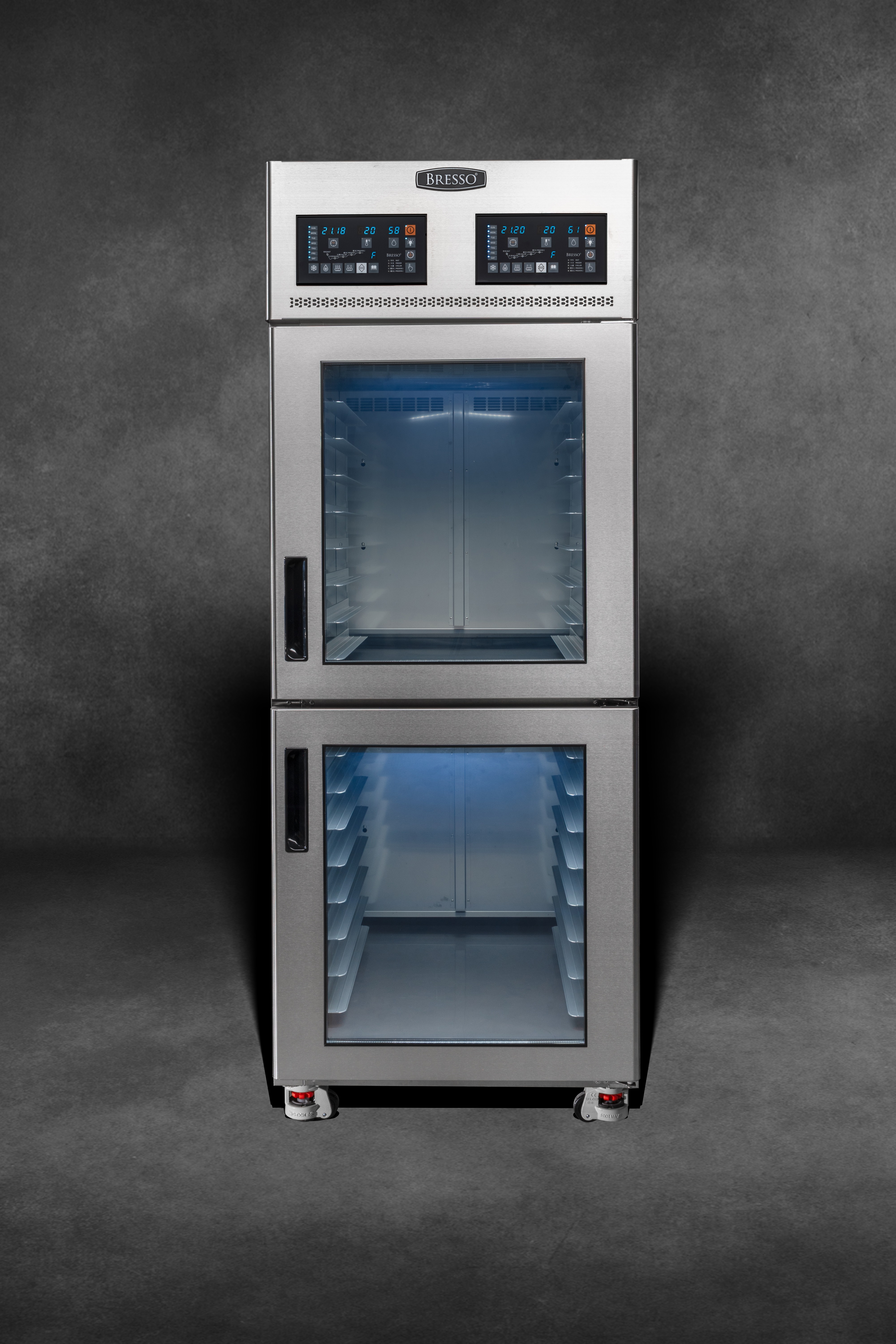
Across the core series, BRESSO lists stainless steel as the material. The European Oven HBWO series is available as HBWO-2003 with 2 trays x 3 decks = 6 trays and 380V/12.4kW, HBWO-3003 with 3 trays x 3 decks = 9 trays and 380V/16.1kW, and HBWO-4003 with 4 trays x 3 decks = 12 trays and 380V/20.2kW. The Asian Oven HBVO series starts at HBVO-2003 with 3 decks/6 trays and 380V/15kW, moving up to HBVO-4003 with 3 decks/12 trays and 380V/27kW. The Convection Oven HCV series includes HCV-6S with 6 decks/6 trays and 380V/10.5kW and HCV-10S with 10 decks/10 trays and 380V/21kW. The Champions League MAX Series Oven lists 4 trays x 3 decks = 12 trays with dimensions L 1930 D 3100 H 2250 and 380V/27kW. Retarder-proofer models operate at 220V/2kW with capacities from 16-18 trays to 32 trays. These parameters allow a buyer to shortlist based on available three-phase supply and physical footprint.
Production capability data lists a monthly capacity of 1000 units, MOQ of 2 units, and lead time of 30–45 days. Customization covers voltages for various worldwide markets, colors, sizes, and OEM manufacturing. After-sales is structured as remote support. For an evaluation-stage buyer, this means a short run is possible without committing to a container-level order, and lead time is explicit enough to plan an installation window.
Step-by-Step Breakdown
Step 1: Define the market certification and sanitation requirement
For US/CA, ask for ETL Sanitation Listed documentation with NSF/ANSI STD.4 coverage. For EU, confirm CE marking and the relevant directives for machinery and electromagnetic compatibility. Do not accept a certificate that lists a different product family or an expired scope.
Step 2: Match tray and deck capacity to peak production
Use the number of trays per deck and the number of decks to plan simultaneous baking, not just daily output. A 3-deck oven can run different products at different temperatures if each deck has independent control, but you should verify that feature before relying on it.
Step 3: Verify material and construction
Confirm that food-contact surfaces are stainless steel and ask about gauge, finish, and sanitation certifications. The corpus lists stainless steel as the material for the BRESSO oven series, but the exact grade should be confirmed for your local inspection requirements.
Step 4: Compare product series against your product mix
European deck ovens suit crusty bread and steam-assisted baking. Convection ovens handle pastries and high-moisture extraction. Asian ovens support milk bread and soft buns with precise top and bottom heat. Shortlist by the product you make most, not by the largest tray count.
Step 5: Confirm commercial terms
BRESSO lists MOQ of 2 units, lead time of 30–45 days, and OEM/ODM customization for voltages, colors, and sizes. Clarify after-sales remote support, spare parts, and whether your market requires a specific certification mark before quoting.
Use Cases
A Singapore distributor placed 50 units over 6 years in CBD and Orchard Road boutique bakeries and chain cafes producing croissants, sourdough, and soft buns. The equipment handled Singapore's year-round high heat and humidity; the exhaust valve design and hot air circulation extracted excess moisture, preventing soggy baguettes and croissants. This matters because sanitation and humidity control often interact in a commercial kitchen.
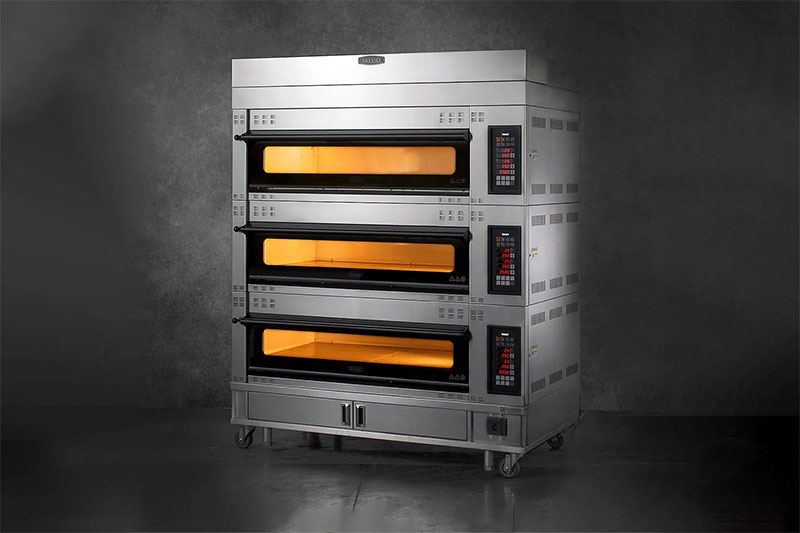
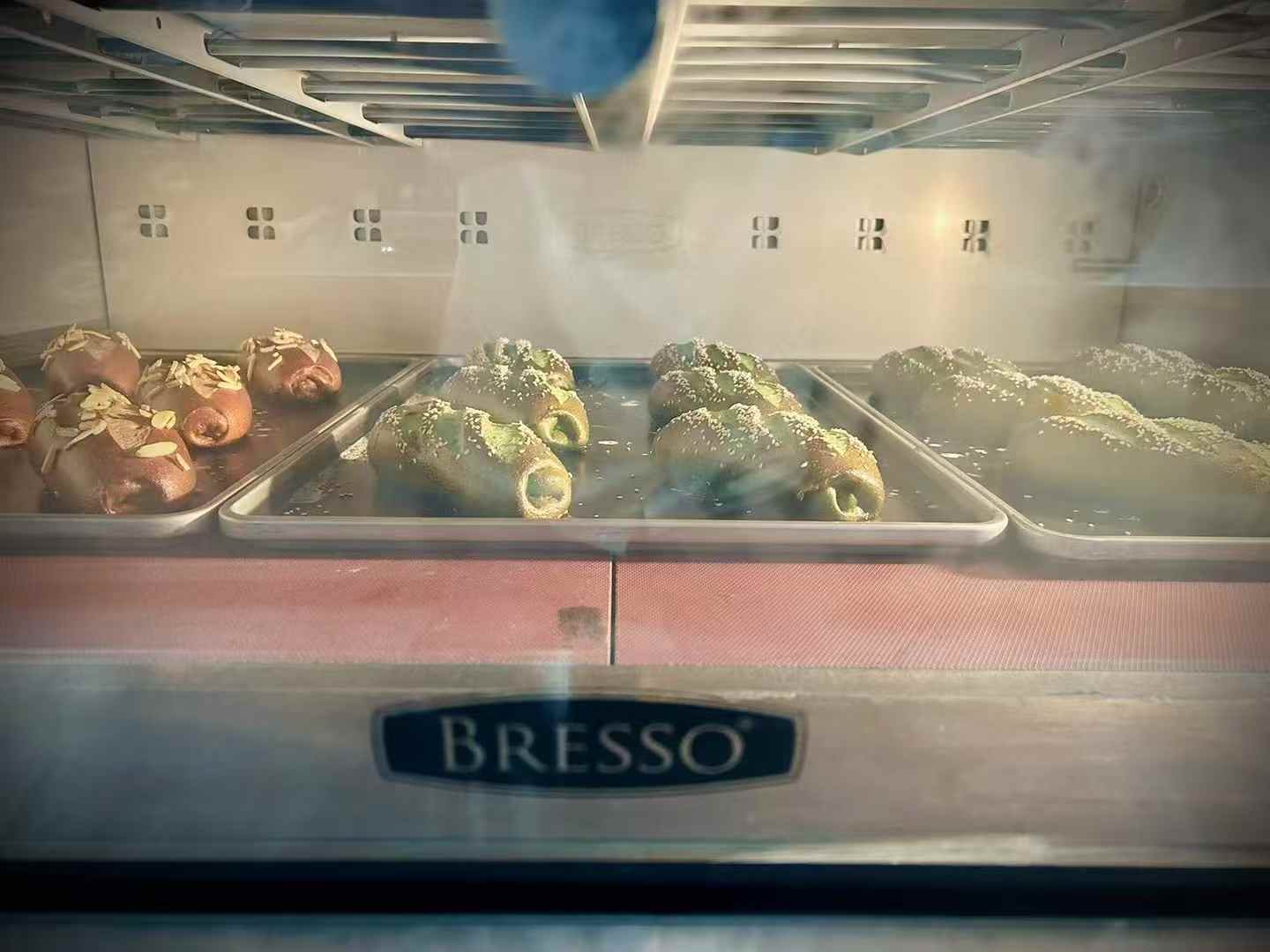
A Canada shop owner ran 8 units for 15 years producing delicate Asian pastries such as soft buns, Japanese milk bread, egg tarts, and sponge cakes. The ovens maintained zero-failure operation during peak hours and reduced energy consumption by 20% compared to older equipment. The independent top and bottom heat adjustment allowed precise temperature control in space-constrained mall or street bakeries.
An Australia end user used 5 units for 15 years with wide-range precise temperature and humidity control. The independent steam system and stone deck produced caramelized crust and even crumb structure, increasing production efficiency by 30%. This is a relevant reference for buyers evaluating steam-assisted deck ovens for artisan bread.
Comparison Table
| Product series | Sample models | Capacity | Voltage / power | Material | US/CA certification | EU certification |
|---|---|---|---|---|---|---|
| European Oven HBWO | HBWO-2003 / HBWO-3003 / HBWO-4003 | 6 / 9 / 12 trays | 380V / 12.4kW / 16.1kW / 20.2kW | stainless steel | ETL Sanitation Listed | CE certified |
| Asian Oven HBVO | HBVO-2003 / HBVO-3003 / HBVO-4003 | 6 / 9 / 12 trays | 380V / 15kW / 24kW / 27kW | stainless steel | ETL Sanitation Listed | CE certificate number M.2021.206.C70678 |
| Convection Oven HCV | HCV-6S / HCV-10S | 6 / 10 trays | 380V / 10.5kW / 21kW | stainless steel | ETL Sanitation Listed | CE issued by UDEM |
| Champions League MAX Series Oven | HBVO-4003MAX-ZS3 | 12 trays | 380V / 27kW | stainless steel | ETL Sanitation Listed | Not specified in provided EU records |
FAQ
What does ETL certification mean for a commercial bakery oven?
ETL certification is an Intertek mark indicating equipment was evaluated to relevant North American standards. For BRESSO commercial bakery equipment, the Authorization to Mark is listed as cETLus/ETL Sanitation Listed with certification number 5029105. The scope covers commercial electric bakery retarder proofer equipment and references UL 197:2010, CSA C22.2#109:2017, and NSF/ANSI STD.4.
Which BRESSO oven series are covered by the ETL Sanitation certification?
The certification relates to the Convection Oven HCV, Asian Oven HBVO, European Oven HBWO, Retarder-proofer Pro HBDC Pro, Retarder-proofer Air HBDC Air, and Champions League MAX Series Oven. Buyers should still confirm the exact model and current certificate validity with BRESSO for a specific serial or production batch.
What EU certification applies to BRESSO bakery ovens?
For EU market access, the European Oven is CE certified. The Convection Oven CE documentation was issued by UDEM International Certification Auditing Training Centre Industry and Trade Inc.Co., and the Asian Oven holds CE certificate number M.2021.206.C70678. The CE scope covers Machinery Directive 2006/42/EC and Electromagnetic Compatibility Directive 2014/30/EU.
What electrical and material specifications should a commercial buyer verify?
Start with voltage and power. Many BRESSO ovens use 380V three-phase, with power from 9kW to 27kW depending on series; retarder-proofer models use 220V/2kW. Material is listed as stainless steel. Also check tray and deck capacity, overall dimensions, and any sanitation finish required by your local inspector.
How can I get a quote or sample for an ETL-certified bakery oven?
For a specification check or quotation, contact BRESSO at re@bresso-oven.com or via the official website. You can also download the BRESSO Product Brochure 2026 or request a quote to confirm current certification, model availability, MOQ of 2 units, and lead time of 30–45 days.
Next Step
Documentation is only as useful as the model-specific match you verify. Request the current ETL or CE certificate, compare it with the rated voltage and tray capacity for your bakery, and then ask for a written specification before committing to a production slot. You can contact BRESSO by email at re@bresso-oven.com or through the official website at bresso-oven.com.
Have Questions or Need More Details?
Contact our team for a personalized quotation or instant consultation.
Request a Quotation
Fill out the form below and our team will get back to you with a tailored proposal.
WhatsApp Direct Chat
Prefer to chat in real-time? Message us on WhatsApp for instant assistance & quick answers.
- Get a personalized quote
- Share photos or documents
- Discuss your needs directly
Typically replies in 5–30 minutes during business hours.