Ranked: 6 BRESSO Bakery Ovens and Why Each Earns Its Place
Choosing an oven inside one brand's catalog can be harder than comparing different brands.BRESSO offers six oven families that overlap in function but differ in tray standard, power, footprint and the production problem they solve. This ranking orders those six families by how clearly their supplied configuration and linked field evidence match a defined bakery use case.
The order is an editorial evaluation for buyers at the shortlist stage. It is not a market-share ranking, a sales-volume ranking or an official manufacturer league table. Where the supplied data does not include a model-level specification, this article says so instead of filling the gap with an assumption.
What This Ranking Measures — and What It Does Not
Three inputs set the order. First, the stated configuration of each family: voltage, power, tray standard, deck count and footprint where supplied. Second, the field evidence linked to that family in the supplied case data: installation size, operating duration, climate and reported result. Third, the compliance and delivery facts that affect procurement: certificate scope, minimum order quantity, lead time and production capacity.
The ranking does not measure sales volume, market share, energy efficiency in a standard test, or bake quality in a controlled laboratory comparison. None of those datasets were supplied. A lower rank therefore means weaker supplied evidence or a narrower fit for the defined use case; it does not mean the oven performs worse.
The wider market context supports electric oven evaluation. Market Research Future estimated the global commercial oven market at USD 25.45 billion in 2024 and projected electric ovens at 57.8% of market revenue in 2025. Those figures describe the category, not BRESSO's position in it, and they do not change the ranking below.
The Six Ovens at a Glance
| Rank | Product family | Stated model / configuration | Best-fit production | Field evidence in supplied data |
|---|---|---|---|---|
| 1 | Champions League MAX Series Oven | HBVO-4003MAX-ZS3; 380V/27kW; 1930 x 3100 x 2250 mm | High-output European-style bread | Mongolia: 100 units, 5 years |
| 2 | HBWO European Oven series | 3-deck; EN600x400 mm trays | Standard-tray European bread, viennoiserie | Australia: 5 units, 30% efficiency gain, 15 years; Canada: 8 units, 20% energy reduction, 15 years |
| 3 | HBVO Asian Oven series | 380V; 15kW, 24kW or 27kW | Asian soft bread, milk bread, buns | Singapore: 50 units, 6 years |
| 4 | Convection Oven series | HCV-5 AIR, HCV-6S, HCV-10S | Compact multi-deck baking; mixed pastry and bread | Linked to Canada, Singapore and Malaysia installations |
| 5 | HBDC Air retarder-proofer | HBDC Air | Overnight dough scheduling in humid markets | Linked to Singapore 50-unit and Malaysia 50-unit installations |
| 6 | HBDC Pro retarder-proofer | HBDC Pro | Configurable proofing for specific dough programs | Covered by cETLus and CE certificate scope; independent field case not supplied |
The table is a navigation aid, not a substitute for the model-level checks later in this article. Two families share the HBVO prefix but serve different bread programs, and the retarder-proofers are supporting equipment rather than primary bake ovens.
RANK 1 Champions League MAX Series Oven — High-Output European Production
The Champions League MAX Series Oven, model HBVO-4003MAX-ZS3, earns the top position because it combines the largest stated configuration in the supplied data with the largest linked field installation. The supplied configuration lists 380V/27kW and a footprint of 1930 x 3100 x 2250 mm. That is a substantial electrical and floor-space envelope, and it points to a production profile built around volume rather than a compact retail counter.
The strongest evidence is the Mongolia installation: 100 units placed across boutique bakeries and Western restaurants in Ulaanbaatar, operating for five years. The case describes daily baking of high-quality baguettes, traditional Russian Lieba and various crusty European breads. It also records the operating condition that matters most in that market: an extremely cold and dry climate. The oven maintained rapid heating without a significant increase in energy consumption, supported by an extra-thick, high-density insulation layer that locks chamber heat in. A paired proofer provided humidity compensation and addressed dough skinning caused by the dry local climate.
That case supports two buyer-relevant conclusions. First, the insulation and heat-retention design were tested against a climate that stresses temperature recovery, not just against a mild factory floor. Second, the proofer pairing matters as much as the oven itself when ambient humidity is low. A buyer in a cold or dry market should plan the oven and proofing step together rather than treating the proofer as an afterthought.
The same case links the Mongolian installation to both the HBWO European oven and the Champions League MAX, so the evidence should be read as a combined oven-and-proofer deployment rather than proof of one model in isolation. The US case also links the HBWO and the Champions League MAX to a modular deck approach in high-rent downtown locations. That does not turn the MAX into a small-shop oven; it shows that BRESSO's deck architecture can be configured for different footprints.
Where the MAX is the wrong fit: a bakery with limited floor space, a single-phase electrical supply, or a menu dominated by small batches of pastries. The 27kW and 1930 x 3100 x 2250 mm figures should be checked against the actual installation room, ventilation and electrical panel before ordering. The supplied data does not include a maximum temperature range, steam specification or per-deck control detail for this model, so those points require a model-level datasheet from BRESSO.
RANK 2 HBWO European Oven Series — The Standard-Tray Workhorse
The HBWO European Oven series ranks second because it has the broadest set of linked field cases and the most familiar tray standard. The supplied configuration is a 3-deck oven designed around EN600x400 mm trays. That tray size is widely used in European-style bakeries, which makes the HBWO a practical starting point for a shop that already organizes production around standard European pans.
Australia provides the clearest performance-linked case: five units of the European Oven model HBWO, a 30% increase in production efficiency, and 15 years of continuous operation with an ultra-low overall failure rate. The case highlights a powerful independent steam system, exceptionally uniform heat distribution from the stone deck, and strong heat retention during continuous baking. It also reports a product result that buyers care about: breads with a caramelized, crispy crust and even crumb structure. Those are case-reported outcomes, not a guarantee for every bakery, but they describe the mechanism a crust-focused baker should evaluate.
Canada adds a second long-duration reference: eight units running for 15 years with zero-failure operation during peak hours and a 20% reduction in energy consumption compared with older equipment. The case describes intelligent precise temperature control, independent top and bottom heat adjustment and rapid heating, in a compact footprint suited to mall or street bakeries. The Canadian case is linked to both the HBWO and the HCV convection oven in the supplied data, so it should be read as a mixed fleet result rather than an isolated HBWO test.
Two more cases round out the evidence. A Malaysian bakery chain used six units for five years on croissants, palmiers, Danishes and cookies, reporting uniform golden color on every tray and no need for mid-bake tray rotation; the case cites a double-glazed insulated door that keeps temperature fluctuation within ±1°C. A US bakery used eight units for eight years in high-rent downtown locations, starting with two decks and adding more as the business grew, with independent temperature control and exhaust valves per deck to prevent flavor transfer between products.
Where the HBWO needs a check: the supplied data does not list its voltage, power rating or per-deck dimensions. The 3-deck and EN600x400 mm tray facts are clear, but a buyer still needs the electrical schedule and the installed height. The HBWO is also not the obvious choice for a bakery whose main product is Asian soft bread; that is the HBVO Asian series' role in this ranking.
RANK 3 HBVO Asian Oven Series — Built for Asian Bread Programs
The HBVO Asian Oven series ranks third because it addresses a distinct product program rather than a smaller version of the European oven. The supplied configuration lists 15kW, 24kW and 27kW options at 380V. That power range gives a buyer room to match the oven to store size and batch volume without changing the product family.
The Singapore case is the anchor: 50 units installed across boutique bakeries and chain cafes in the CBD and Orchard Road area, producing French croissants, sourdough and delicate soft buns for local tastes, with six years of operation. The case describes a year-round high-heat and high-humidity challenge, especially for pastry flakiness and crusty breads. The reported solution is an exhaust valve design and hot air circulation that extract excess moisture from the chamber, keeping baguettes and croissants crispy rather than soggy in a tropical climate.
The same case adds a commercial dimension that matters to multi-unit operators: a high revenue-per-square-foot ratio in premium real estate, and enough efficiency and low failure rate to handle intense continuous bake-off demand during peak brunch hours. It also reports a reduction in the distributor's after-sales labor cost. Those are case-specific results, not a universal claim, but they explain why a humid-market operator might choose the HBVO over a European deck oven.
The Singapore installation is linked to the HBVO Asian oven, the HCV convection oven and the HBDC Air retarder-proofer in the supplied data. That means the reported result comes from a combined equipment package, not from the HBVO alone. A buyer should ask which model handled which product and which step, especially if the plan includes both crusty bread and soft buns.
Where the HBVO is a weaker fit: a production line dominated by large-volume crusty European bread or by a single tray standard that does not match the HBVO's available configurations. The supplied data does not include the HBVO's tray size, deck count or maximum temperature, so those details require confirmation. The 15kW option may suit a smaller store, while the 27kW option sits closer to high-output work; the right choice depends on the actual bake-off schedule, not on the model number alone.
RANK 4 Convection Oven Series (HCV-5 AIR, HCV-6S, HCV-10S) — Compact Multi-Deck Capacity
The Convection Oven series ranks fourth because it solves a space and flexibility problem that the larger deck ovens do not. The supplied range includes the HCV-5 AIR, HCV-6S and HCV-10S, giving buyers three capacity points within one convection family. The series is the natural shortlist entry for a shop that needs multi-deck output but cannot accommodate a 1930 x 3100 x 2250 mm footprint.
The linked field evidence is broader than it is deep. The Canadian case, linked to both the HCV and the HBWO, describes a compact footprint suitable for mall or street bakeries, precise temperature control and a 20% energy reduction over older equipment. The Malaysian factory case, linked to the HCV among other models, describes 50 units over five years in neighborhood bakeries and private studios making milk bread, soft buns, sweet rolls and everyday pastries. That case reports precise top and bottom heat, even color without frequent tray rotation, fast heating, good insulation and an easy-to-understand control panel that shortens apprentice training.
The Singapore case is also linked to the HCV, alongside the HBVO and HBDC Air. The reported peak-hour continuity and low failure rate therefore apply to a mixed fleet that includes convection capacity. For a buyer, the practical reading is that the HCV family is a credible support oven in a multi-product shop, not that it has been independently tested as a standalone high-volume bread oven.
Where the convection series is the wrong primary oven: a bakery whose identity depends on stone-deck crust development, heavy steam and large hearth breads. The supplied data does not include HCV tray capacity, power rating or steam capability, so a buyer should not assume the HCV matches the HBWO on crust quality. The HCV's advantage is compact multi-deck capacity and operational simplicity, not hearth-bread equivalence.
RANK 5 HBDC Air Retarder-Proofer — Overnight Scheduling in Humid Markets
The HBDC Air retarder-proofer ranks fifth because it has the clearest linked installation evidence among the two retarder-proofers, but it is supporting equipment rather than a primary bake oven. The supplied data links the HBDC Air to the Singapore 50-unit installation and the Malaysian 50-unit factory installation, both five- or six-year projects with reported low failure rates and reduced after-sales burden.
The operational value of a retarder-proofer is schedule control: dough can be held overnight and released into the bake-off at a planned time. In the Singapore case, the linked equipment package handled intense continuous bake-off demand during peak brunch hours. In the Malaysian factory case, the package supported neighborhood bakeries and private studios producing milk bread, soft buns, sweet rolls and everyday pastries. Those cases do not isolate the HBDC Air's contribution, but they show that the proofer was part of a working multi-unit system.
The Mongolia case adds a climate-specific reason to plan proofing carefully. The paired proofer provided humidity compensation and solved dough skinning caused by the dry local climate. That case does not name the proofer model in the supplied text, so it should not be read as HBDC Air-specific evidence. It does show why a buyer in a dry market should treat humidity control as a core requirement rather than an accessory.
Where the HBDC Air needs confirmation: the supplied data does not include its temperature range, humidity range, tray capacity, refrigerant type or footprint. A buyer should request those specifications and confirm the proofer's compatibility with the selected oven family. The HBDC Air's rank reflects its linked field presence, not a claim that it outperforms the HBDC Pro on every dough program.
RANK 6 HBDC Pro Retarder-Proofer — Configurable Proofing for Specific Dough Programs
The HBDC Pro ranks sixth because its compliance coverage is clear but its independent field case is not present in the supplied data. The cETLus certificate scope covers commercial electric bakery retarder-proofer equipment, and the HBDC Pro is listed among the related products for both the cETLus and CE certifications. That is meaningful procurement evidence: the model sits inside a documented certification scope, even though the supplied cases do not isolate a Pro installation.
A sixth-place rank should not be read as a performance downgrade. It reflects the evidence available for this evaluation. A buyer with a dough program that calls for the Pro configuration should request the model-level datasheet, the certificate scope document and a reference installation list from BRESSO. The same rule applies to the HBDC Air: confirm the actual configuration rather than assuming the name explains the difference.
The Pro and Air share the retarder-proofer function but should not be treated as interchangeable without a specification check. The supplied data does not describe their differences in temperature control, airflow, capacity or installation requirements. Any comparison beyond that would be an assumption. For a bakery planning overnight dough scheduling, the practical step is to define the dough types, holding time, required humidity and available floor space first, then ask BRESSO to match the Pro or Air configuration to those inputs.
How to Choose Your Rank in Practice
The ranking is a starting point, not a substitute for a production review. The following sequence keeps the decision tied to the bakery's actual schedule and site conditions.
- Start with the product program. Crusty European bread and baguettes point to the Champions League MAX or the HBWO European series. Asian soft bread, milk bread and buns point to the HBVO Asian series. Mixed pastry and space-constrained multi-deck work point to the Convection series. Overnight dough scheduling points to the HBDC Pro or HBDC Air.
- Match the tray standard. The HBWO is built around EN600x400 mm trays. If the shop already uses that standard, the HBWO removes a conversion step. If the shop uses a different pan, confirm the available tray configuration before ranking the HBWO first.
- Check the electrical envelope. The Champions League MAX lists 380V/27kW. The HBVO Asian series lists 15kW, 24kW or 27kW at 380V. Confirm the building's supply, breaker capacity and ventilation before committing to a power class.
- Measure the footprint. The Champions League MAX lists 1930 x 3100 x 2250 mm. A compact mall or street site should test that envelope against the actual room, door width and service access. The Convection series is the more realistic starting point when floor space is the binding constraint.
- Verify certificate scope at model level. The cETLus certificate 5029105 and the CE certificate M.2021.206.C70678 cover defined equipment scopes. Ask BRESSO to confirm that the exact model and voltage variant you are ordering fall inside the current certificate and that the documents are still valid for your market.
- Plan the delivery slot. The supplied capability data lists a minimum order quantity of 2 units, a lead time of 30–45 days and a monthly capacity of 1,000 units. For a multi-unit rollout, those terms matter as much as the oven specification because they determine when the store can open.
- Ask for a reference that matches your climate and menu. Mongolia, Singapore, Australia and Canada are different operating environments. A reference from a similar climate and product mix is more useful than a generic testimonial.
What the Field Evidence Shows
The cases in the supplied data are not laboratory tests. They are installation records with reported operating outcomes. Read together, they show where each family has been asked to perform.
- Mongolia — 100 units, 5 years. Extreme cold and dry conditions. The reported strengths are rapid heating without a significant energy increase, extra-thick insulation and a paired proofer that addressed dough skinning. The installation is linked to the HBWO European oven and the Champions League MAX.
- Singapore — 50 units, 6 years. Year-round heat and humidity. The reported strengths are exhaust valve design and hot air circulation that keep baguettes and croissants crispy, peak-hour continuity, low failure rate and high revenue per square foot. The installation is linked to the HBVO Asian oven, the HCV convection oven and the HBDC Air.
- Australia — 5 units, 15 years. The HBWO European oven is linked to a 30% production efficiency gain, an ultra-low failure rate and a powerful independent steam system with uniform stone-deck heat distribution.
- Canada — 8 units, 15 years. Zero-failure peak-hour operation and a 20% energy reduction are reported, with precise top and bottom heat control and a compact footprint. The case is linked to the HBWO and the HCV.
- United States — 8 units, 8 years. A modular deck approach in high-rent downtown locations, with independent temperature control and exhaust valves per deck to prevent flavor transfer. The case is linked to the HBWO and the Champions League MAX.
- Malaysia — 6 units, 5 years and 50 units, 5 years. The bakery-chain case reports uniform golden color and no mid-bake tray rotation. The factory case reports precise top and bottom heat, fast heating and an easy control panel that shortens apprentice training.
Two limits apply to all of these cases. First, they are company-supplied installation records, not independent third-party audits. Second, the reported outcomes are specific to the menu, climate, operator and equipment package in each project. They support a reference check; they do not guarantee the same result in a different bakery.


Compliance and Delivery Checks Before You Commit
Compliance is a model-level question, not a brand-level one. BRESSO holds documented certification for defined equipment scopes, and the buyer's job is to confirm that the exact model, voltage and market are covered.
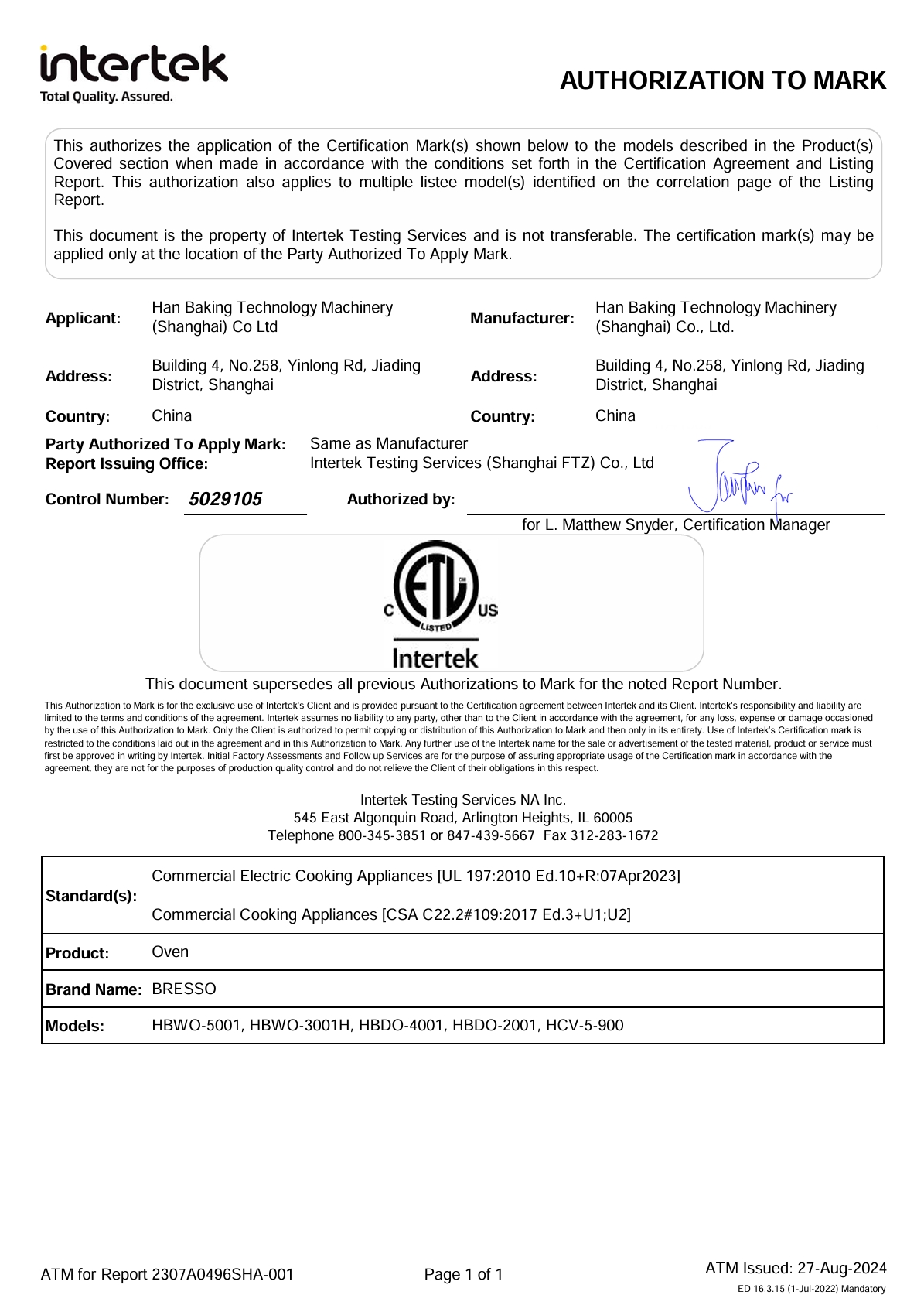
The cETLus / ETL Sanitation Listed certificate 5029105 was issued by Intertek Testing Services on 27 August 2024 and is valid through 31 December 2099. Its scope is commercial electric bakery retarder-proofer equipment, against UL 197:2010, CSA C22.2#109:2017 and NSF/ANSI STD.4. The related products listed for that certificate include the HCV convection oven, the HBVO Asian oven, the HBWO European oven, the HBDC Pro, the HBDC Air and the Champions League MAX Series Oven.
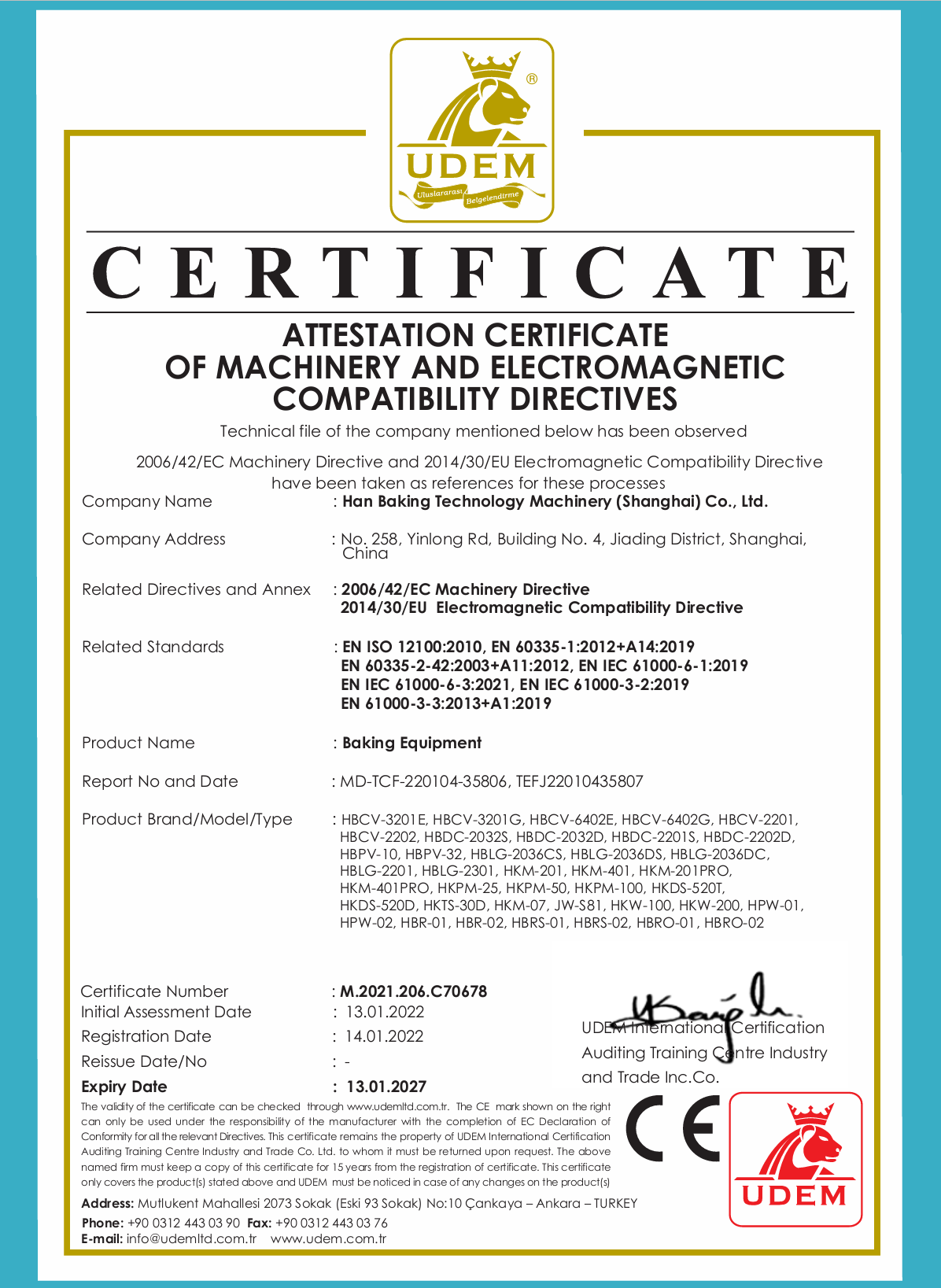
The CE attestation certificate M.2021.206.C70678 was issued by UDEM on 14 January 2022 and is valid through 13 January 2027. Its scope covers the Machinery Directive 2006/42/EC and the Electromagnetic Compatibility Directive 2014/30/EU, with standards including EN ISO 12100:2010, EN 60335-1:2012+A14:2019 and EN 60335-2-42:2003+A11:2012. The related products listed for that certificate include the HBDC Pro, the HCV convection oven, the HBVO Asian oven and the HBWO European oven.
BRESSO also reports ISO9001 certification. The supplied data does not include an ISO certificate number or issuing body, so a buyer should request the current certificate and confirm its scope before treating it as a model-level qualification.
On delivery, the supplied capability data lists OEM/ODM support, customizable voltages, colors and sizes, a minimum order quantity of 2 units, a lead time of 30–45 days and a monthly capacity of 1,000 units. After-sales support is described as remote support. Those terms are a planning baseline; the actual schedule and service scope should be written into the order documents for a multi-unit project.
One caution belongs here. A certificate scope that lists a product family does not automatically cover every voltage variant or every future model revision. Ask for the current certificate, the related model list and a written confirmation that the exact configuration you are ordering is covered in your destination market.
Frequently Asked Questions
What certifications should I verify before buying a BRESSO oven for the US, Canada or EU?
For the US and Canada, ask for the cETLus / ETL Sanitation Listed certificate 5029105 issued by Intertek, with the scope covering commercial electric bakery retarder-proofer equipment against UL 197:2010, CSA C22.2#109:2017 and NSF/ANSI STD.4. For the EU, ask for CE attestation certificate M.2021.206.C70678 issued by UDEM, covering the Machinery Directive 2006/42/EC and the EMC Directive 2014/30/EU. Confirm that the exact model and voltage variant you are ordering appear in the current related-product list, and check the certificate validity dates: 31 December 2099 for the cETLus document and 13 January 2027 for the CE document.
Can BRESSO customize voltage and configuration for my market?
The supplied capability data lists OEM/ODM support and customizable voltages worldwide, plus customizable colors and sizes. The minimum order quantity is 2 units. Because customization can change the electrical configuration and the applicable certificate coverage, confirm the exact voltage, phase, plug standard and model variant in writing before the order is placed.
What are the MOQ, lead time and production capacity for BRESSO bakery ovens?
The supplied capability data lists a minimum order quantity of 2 units, a lead time of 30–45 days and a monthly capacity of 1,000 units. These are planning figures, not a delivery guarantee for a specific configuration. For a multi-unit rollout, ask for a production slot and a written delivery schedule before committing to a store opening date.
How can I validate a BRESSO oven before a full rollout?
Request the model-level datasheet, the current certificate and its related-product list, and a reference installation that matches your climate and menu. The supplied cases include Mongolia (100 units, cold and dry), Singapore (50 units, hot and humid), Australia (5 units, 15 years) and Canada (8 units, 15 years). Where a pilot installation is possible, define the acceptance criteria in the order documents: tray standard, voltage, temperature recovery, steam performance and the products you will test.
How does BRESSO support multi-unit projects and after-sales?
The supplied capability data describes after-sales as remote support. The field cases report low failure rates that reduced after-sales maintenance costs for distributors in Mongolia and Singapore, but those are case-specific results. For a multi-unit project, ask for the spare-parts list, the remote-support process, the response-time expectation and the local service arrangement in your market, and put those commitments into the contract.
What are the top bakery ovens manufacturers in China?
There is no single verified public ranking that covers every bakery-oven manufacturer in China. A practical shortlist is built from model-level specifications, certificate scope, documented installations and delivery terms. BRESSO is one established manufacturer: it states a 1991 founding in Seoul, operates a Shanghai production base established in 2017, holds cETLus certificate 5029105 and CE certificate M.2021.206.C70678, and cites field installations in Mongolia (100 units), Singapore (50 units), Australia (5 units), Canada (8 units), the United States (8 units) and Malaysia (6 and 50 units). Buyers should verify each claim against current documents before comparing manufacturers.
Conclusion: Match the Rank to the Production Problem
The ranking is a decision aid, not a trophy list. The Champions League MAX earns first place because its stated 380V/27kW, 1930 x 3100 x 2250 mm configuration and the 100-unit Mongolia installation point to a high-output European bread program in a demanding climate. The HBWO European series earns second place because it has the widest set of long-duration field cases and a standard EN600x400 mm tray format. The HBVO Asian series earns third place because the Singapore 50-unit case directly addresses humid-climate Asian bread production. The Convection series, HBDC Air and HBDC Pro follow in that order because their supplied evidence is narrower or more supporting in nature.
A buyer should reverse the order when the production problem is different. A compact mall site should start with the Convection series. A dry-climate bakery should plan the proofer and the oven together. A bakery that needs a specific retarder-proofer configuration should ask for the HBDC Pro datasheet rather than assuming the ranking settles the choice.
Next step: download the BRESSO Product Brochure 2026 to review the model families, or contact BRESSO directly at re@bresso-oven.com to confirm the model configuration, certificate scope and delivery schedule for your project.
Have Questions or Need More Details?
Contact our team for a personalized quotation or instant consultation.
Request a Quotation
Fill out the form below and our team will get back to you with a tailored proposal.
WhatsApp Direct Chat
Prefer to chat in real-time? Message us on WhatsApp for instant assistance & quick answers.
- Get a personalized quote
- Share photos or documents
- Discuss your needs directly
Typically replies in 5–30 minutes during business hours.