Bakery Oven Sizing: Decks, Trays, Power & Footprint

A bakery oven specification is not a list of isolated numbers. Deck count sets the number of baking chambers; tray standard sets what fits inside each chamber; voltage and power set the electrical interface; footprint sets what the building can accept. For a technical buyer moving from evaluation to execution, the useful question is not which number is largest, but which combination matches the product mix, site and loading pattern.
BRESSO is a baking equipment brand with roots in South Korea and a production base in Shanghai. Its published families show the trade-off clearly: the HBWO European Oven, HBVO Asian Oven, HCV-5 AIR Convection Oven, HBDC retarder-proofer families and the Champions League MAX Series. This guide uses the supplied specifications for those families to show how to read a bakery oven sheet before a purchase order.
Problem definition: why four parameters decide the line
Most specification errors occur at interfaces, not at the centre of the oven. A three-deck oven can be right for one shop and wrong for another because the limiting factor may be depth, not deck count. A tray that fits the chamber may still be difficult to load if the door swing is restricted. A 27 kW unit may be technically suitable but impossible to connect without a panel upgrade. A proofer may have a low electrical load yet create a bottleneck because it adds process time and floor space.
The practical task is to align four variables before comparing model names: deck count and chamber control, tray standard and loading path, voltage and connected power, and external footprint with clearances. When those four are fixed, the oven family becomes a procurement choice rather than a layout risk.
Industry background: electric ovens and specification risk
Electric bakery ovens are a major part of the commercial oven category. Market Research Future's 2026 report estimated the global commercial oven market at USD 25.45 billion in 2024 and forecast electric ovens to account for 57.8% of revenue in 2025. For a specifier, the practical implication is that electrical planning deserves the same attention as deck count. A model that looks efficient on paper can still fail at commissioning if the site supply, cable route, breaker capacity or ventilation does not match the supplied rating.
The technical guide below is therefore written for the evaluation-to-execution stage: the buyer already knows that a deck oven, convection oven or retarder-proofer is relevant, and now needs to match model-level data to a real room and a real bake schedule.
The four-parameter specification framework
Use the following sequence for every bakery oven enquiry. It prevents a low-priority feature from hiding a hard constraint.
- Deck count and control: How many independent baking chambers are needed, and does each deck have the control and exhaust behaviour required for the product mix?
- Tray standard and loading: What tray footprint is used, how many trays fit per deck, and can staff load and unload safely at production speed?
- Voltage and power: What supply is available, what is the connected load, and what electrical work is needed before installation?
- Footprint and clearance: What are the external length, depth and height, and what space is required for door swing, aisles, extraction and service access?
Throughput sits on top of these four variables. At line level, trays per cycle depend on trays per deck multiplied by the number of decks. Cycles per hour depend on bake time, loading and unloading, and recovery between batches. The oven sheet supplies only part of that chain, so a power rating should never be treated as a throughput guarantee.
Deck architecture and tray standard: HBWO European Oven
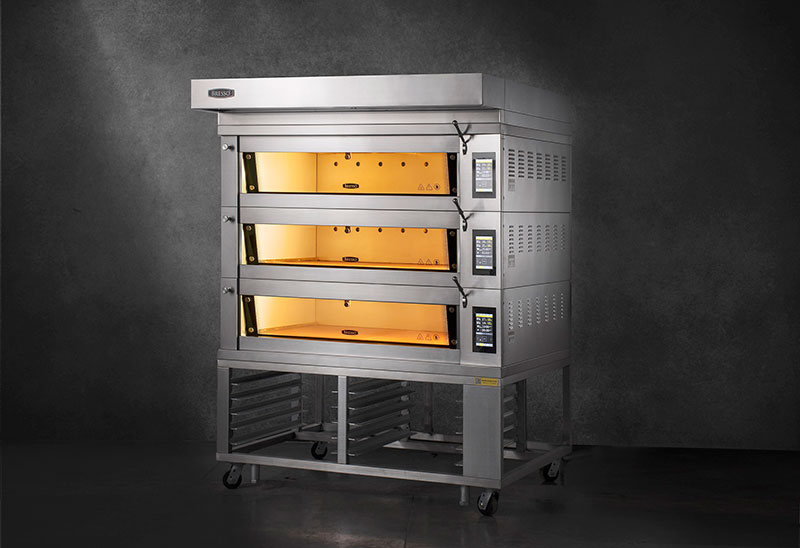
The HBWO European Oven is supplied as a 3-deck structure with EN 600 x 400 mm trays. The family is described through a 2003/3003/4003 progression. For a specifier, that progression is a configuration ladder within the same European oven architecture: confirm deck count, trays per deck, connected load and external dimensions on the model-specific sheet rather than assuming that the model number alone defines the complete electrical or footprint package.
EN 600 x 400 mm is a European tray footprint. It matters because the tray defines the usable chamber, the loading path and the interface with existing racks, benches and packaging. If a bakery already uses EN 600 x 400 mm trays, the HBWO family is easier to integrate into existing handling than a format that requires new trays and new storage. That is a logistics advantage, not a baking-performance claim.
Three decks allow different products or temperatures by deck, but the control architecture must be confirmed for the exact model. In a documented US bakery case, 8 units of the European Oven HBWO were used to bake high-temperature milk bread on the top deck and low-temperature chiffon cake on the bottom deck within a minimal footprint. Each deck had independent temperature control and exhaust valves, and the modular design allowed starting with two decks and adding more as the business grew. That case shows why deck-level control belongs in the specification conversation; it does not prove that every HBWO configuration has the same control package.
HBVO Asian Oven range: voltage, power and width
The HBVO Asian Oven range is supplied at 380 V with a power range from 15 kW to 27 kW. External dimensions run from L1330 x D1200 x H2065 mm to L1730 x D1200 x H2065 mm. The constant depth and height are useful for line planning: the variable is width, and width usually travels with the selected configuration. Do not read the smallest width as automatically the lowest-output unit or the largest width as automatically the highest-power unit; match the model sheet to the intended deck and tray arrangement.
For an Asian oven used for soft buns, milk bread and similar products, even top and bottom heat is often a more useful discussion than nominal power alone. In a documented Malaysia factory case, 50 units of the HCV-related installation served neighbourhood bakeries and private studios making milk bread, soft buns, sweet rolls and everyday pastries. The reported result was highly precise top and bottom heat for even colour on a tray of milk bread, with no need for frequent tray rotation. The same case notes fast heating, good insulation and an easy-to-understand control panel that reduced training costs. Those are application outcomes from a supplied case, not a universal guarantee.
Convection Oven HCV-5 AIR: five decks, nine kilowatts
The HCV-5 AIR Convection Oven is listed at 380 V/9 kW, with external dimensions of L1900 x D1220 x H2065 mm and a configuration of 5 decks and 5 trays. The lower power rating compared with the high end of the HBVO range should not be read as lower capability across all products. It reflects a different oven architecture and a different loading pattern: five deck levels with one tray per deck.
Convection airflow is relevant for delicate pastry and even browning, but airflow has to be matched to the product. In a documented Malaysia bakery chain case, 6 units were installed across boutique French patisseries. The report describes gentle convection airflow that preserved delicate pastry layers and a double-glazed insulated door that maintained temperature within ±1°C. Bakers no longer needed to rotate trays manually, and croissants achieved uniform golden colour, distinct flaky layers and a crispy texture. For a specifier, the lesson is to ask for airflow behaviour, door sealing and temperature stability data, not just the kW rating.
HBDC retarder-proofers: 220 V/2 kW across 18 and 32 trays
The HBDC retarder-proofer families run at 220 V/2 kW across 18-tray and 32-tray configurations. This is a low electrical load compared with the ovens, but it is not a low-impact line item. A retarder-proofer adds process time, floor space and humidity control. The 18-tray and 32-tray choices are about batch scheduling, dough handling and the space available for loading and unloading.
In a documented Mongolia case, a distributor installed 100 units across boutique bakeries and Western restaurants in Ulaanbaatar. The paired proofer provided humidity compensation and solved dough skinning in a cold, dry climate, while the oven's extra-thick, high-density insulation helped retain chamber heat. That case links proofer capacity and climate control to product quality, not just to oven power. It also shows why the proofer should be specified with the oven rather than added after the oven layout is fixed.
Champions League MAX Series: reading a line-level specification
The Champions League MAX Series specification supplied for this guide lists 1930 x 3100 x 2250 mm, 380 V and 27 kW. The first number to read is depth: 3100 mm is substantially deeper than the 1200 mm to 1220 mm depth of the HBVO and HCV-5 AIR models described above. A line planner must check door swing, tray loading aisle, extraction duct, floor loading and electrical panel capacity before placing the unit.
The 27 kW load is the top of the HBVO range in this brief. It should be planned as a defined electrical requirement, not added to an existing circuit without verification. The specification does not by itself state throughput, bake time or recovery. Use it to size the space and electrical interface, then request the model-specific bake and recovery data for the intended product.
How the trade-offs work against throughput
Deck count, tray standard, power and footprint trade against throughput in different ways. More decks can increase the number of trays in a single load, but they also raise the loading height and can increase the time needed to load and unload. A wider oven can accept a larger tray or more trays per deck, but it also consumes more wall length and may change the traffic path in a tight shop.
Power is a connected load, not a promise of faster baking. A 9 kW convection oven and a 27 kW deck oven do different work; comparing kW alone is not a like-for-like comparison. The same caution applies to voltage. A 220 V retarder-proofer and a 380 V oven may sit in the same line, but they require different supply arrangements and should be sequenced in the electrical plan.
Footprint is often the final constraint because it is visible. Measure the external length, depth and height, then add clearance for door swing, operator access, extraction and service. A unit that fits the room but cannot be loaded safely is not a fit. A unit that can be loaded but blocks the aisle is also not a fit.
Step-by-step: sizing a line from spec sheet to installation
- Lock the product mix and tray format. Decide whether the line will use EN 600 x 400 mm trays, how many products will run at once, and whether different decks need different temperatures. This step determines whether a 3-deck HBWO, a 5-deck HCV-5 AIR or a wider HBVO configuration is even relevant.
- Calculate trays per bake and deck count. Count the trays needed for the peak bake, then check trays per deck and the number of decks. Confirm that the loading height and door opening support the staff who will use the oven every day.
- Map voltage and power to the site. Record the supplied voltage and kW for each candidate: HBVO at 380 V and 15 kW to 27 kW; HCV-5 AIR at 380 V/9 kW; HBDC at 220 V/2 kW; Champions League MAX Series at 380 V/27 kW. Have a qualified electrician verify the supply, protection and cable route before the order is placed.
- Draw the footprint with clearances. Use the external dimensions and add door swing, aisle, extraction and service space. For the Champions League MAX Series, treat the 3100 mm depth as a line-layout constraint, not a minor detail.
- Specify the retarder-proofer with the oven. Choose 18-tray or 32-tray HBDC capacity against the dough schedule and the floor space. Check humidity and temperature control requirements for the local climate.
- Verify certification scope. Match the certificate to the exact model and market. A family-level statement is not enough for a purchase order.
- Request a sample or factory acceptance check. Bake the intended products on the proposed tray format and review the startup, loading and cleaning routine with the people who will operate the line.
Use cases: matching architecture to product and climate
High-rent urban bakery with a diverse product range. The US case described above used 8 units of the European Oven HBWO in high-rent downtown locations. The reported benefit was simultaneous high-temperature milk bread baking on the top deck and low-temperature chiffon cake baking on the bottom deck within a minimal footprint. The modular design allowed starting with two decks and adding more as the business grew. For a specifier, this is a reason to ask about independent deck control and future expansion, not a reason to assume that every site needs the same deck count.
Humid tropical climate. A Singapore distributor installed 50 units across boutique bakeries and chain cafes over a 6-year project. The reported highlight was an exhaust valve design and hot air circulation that extracted excess moisture, helping maintain crispy baguettes and croissants in year-round heat and humidity. The same case notes a high revenue-per-square-foot ratio and efficient use of kitchen space in premium real estate. The technical point is that moisture management and footprint can matter as much as nominal oven capacity in a humid market.
Artisan bread and steam. An Australian end-user case reports 5 units of the European Oven HBWO, a 30% increase in production efficiency and a 15-year lifespan in continuous operation. The supplied description highlights a powerful independent steam system, exceptionally uniform heat distribution from the stone deck and strong heat retention. These are reported case outcomes; they should be verified against the exact model and bake schedule rather than treated as a universal performance promise.
Comparison table: supplied specifications at a glance
| Family | Supplied configuration facts | Electrical | Footprint | Specifier check |
|---|---|---|---|---|
| HBWO European Oven | 3-deck structure; EN 600 x 400 mm trays; 2003/3003/4003 progression | Confirm on model sheet | Confirm on model sheet | Deck count, trays per deck, load and clearance |
| HBVO Asian Oven | Range from 15 kW to 27 kW; width varies by model | 380 V | L1330 x D1200 x H2065 mm to L1730 x D1200 x H2065 mm | Selected width, deck and tray arrangement, actual power |
| HCV-5 AIR Convection Oven | 5 decks and 5 trays | 380 V/9 kW | L1900 x D1220 x H2065 mm | Tray size, airflow, door clearance, loading pattern |
| HBDC retarder-proofer | 18-tray and 32-tray configurations | 220 V/2 kW | Confirm on model sheet | Humidity and temperature control, floor drain, batch schedule |
| Champions League MAX Series | Line-level specification | 380 V/27 kW | 1930 x 3100 x 2250 mm | Depth, extraction, panel capacity, loading aisle |
Certification and verification checklist
BRESSO's supplied ETL authorization to mark, certificate 5029105 issued by Intertek, covers commercial electric bakery retarder-proofer equipment under UL 197:2010, CSA C22.2#109:2017 and NSF/ANSI STD.4. Because the scope names retarder-proofer equipment, a buyer should confirm that the exact oven model and market are covered before treating it as an oven certificate. The CE attestation M.2021.206.C70678 covers machinery and electromagnetic compatibility directives for listed products; confirm the model listing and declaration. BRESSO's company profile also states ISO9001 certification; request the current certificate and scope rather than relying on a general statement.
If a project brief calls for ETL-certified bakery ovens, ISO9001 standard bakery ovens, 304 stainless steel bakery ovens, remote monitoring bakery ovens or touch-screen smart bakery ovens, convert each phrase into a verifiable document request. Ask for the certificate number, issuing body, covered model, validity date and material or control specification. Do not assume a feature from a family name.
Planning a line or comparing models? The BRESSO 2026 product brochure provides the product-family overview. Use it with the model-specific datasheet, then request a quotation or sample discussion against your tray format, voltage and footprint.
FAQ
What certifications should I verify for a commercial bakery oven?
Start with the market and the exact model. For North America, ask for the ETL authorization to mark and confirm that certificate 5029105 covers the model; the supplied scope is commercial electric bakery retarder-proofer equipment under UL 197:2010, CSA C22.2#109:2017 and NSF/ANSI STD.4. For the EU, request CE attestation M.2021.206.C70678 and the declaration for the listed product. For quality management, request the current ISO9001 certificate and scope. A family-level claim is not a substitute for model-level verification.
How do deck count and tray standard affect oven selection?
Deck count sets the number of baking chambers; tray standard sets the usable area and the loading path. The HBWO European Oven is supplied as a 3-deck structure with EN 600 x 400 mm trays and a 2003/3003/4003 progression. The HCV-5 AIR has 5 decks and 5 trays. HBDC retarder-proofers are offered in 18-tray and 32-tray configurations. More decks can increase trays per cycle, but they also raise loading height and change the operator routine. Confirm trays per deck, door opening and clearance before choosing.
What voltage and power should I specify?
From the supplied data, the HBVO Asian Oven range runs at 380 V with 15 kW to 27 kW. The HCV-5 AIR is 380 V/9 kW. HBDC retarder-proofers are 220 V/2 kW. The Champions League MAX Series is 380 V/27 kW. Treat kW as connected load, not as a guaranteed output figure. Match the rating to the site supply and have a qualified electrician verify protection, cable route and panel capacity.
How do I read the Champions League MAX Series footprint?
The supplied envelope is 1930 x 3100 x 2250 mm at 380 V and 27 kW. The critical line-planning number is the 3100 mm depth, which is much greater than the 1200 mm to 1220 mm depth of the HBVO and HCV-5 AIR models described in this guide. Plan door swing, loading aisle, extraction, floor loading and panel access before placement. The specification does not state throughput, so request model-specific bake and recovery data for the intended product.
OEM bakery oven manufacturer for commercial bakery shops
BRESSO provides OEM and ODM production services with customization for voltages, colours and sizes. The supplied commercial terms include a MOQ of 2 units, lead time of 30 to 45 days, monthly capacity of 1,000 units and remote after-sales support. For a commercial bakery shop project, provide the product mix, tray format, voltage, footprint and target certification market so the proposal can be matched to the exact model. To take the next step, request a quotation or the 2026 product brochure.
Conclusion
Deck count, tray standard, power and footprint are not independent choices. The HBWO European Oven shows how a 3-deck structure and EN 600 x 400 mm trays fit a European tray system. The HBVO Asian Oven range shows a 380 V, 15 kW to 27 kW band with widths from L1330 to L1730 mm at a constant D1200 x H2065 mm envelope. The HCV-5 AIR adds a 5-deck, 5-tray convection option at 380 V/9 kW and L1900 x D1220 x H2065 mm. The HBDC families add 220 V/2 kW retarder-proofer capacity in 18-tray and 32-tray formats. The Champions League MAX Series shows why a 1930 x 3100 x 2250 mm, 380 V, 27 kW line-level unit needs to be read as a space and electrical decision, not just a model name.
Use the four-parameter method, verify the model-specific sheet, confirm certification scope and test the loading routine before the purchase order. That is how a bakery oven specification becomes an executable line rather than a collection of attractive numbers.
Have Questions or Need More Details?
Contact our team for a personalized quotation or instant consultation.
Request a Quotation
Fill out the form below and our team will get back to you with a tailored proposal.
WhatsApp Direct Chat
Prefer to chat in real-time? Message us on WhatsApp for instant assistance & quick answers.
- Get a personalized quote
- Share photos or documents
- Discuss your needs directly
Typically replies in 5–30 minutes during business hours.