
Compliance Essentials for Bakery Ovens: Voltage Standards and Manufacturing Code Alignment
Bakery oven compliance is settled by two documents, not by a sales presentation. The model nameplate fixes the rated voltage of the exact unit being shipped. The factory's quality-management code fixes how that unit was built, inspected and recorded. BRESSO, a baking-equipment manufacturer established in 1991 in Seoul, South Korea, with a production base in Shanghai, China, states a 380 V rating for its ovens and a 220 V rating for its retarder-proofers. Those two numbers, together with the document trail behind them, decide whether an installation passes inspection or stalls at commissioning.
This guide is written for buyers in the decision and execution stages: importers, distributors, chain bakery operators and project engineers who must align a purchase order with the electrical and manufacturing rules of the destination market. It covers voltage alignment, protective-device documentation, stainless steel construction requirements and manufacturing-code evidence, using the HBVO, HBWO, HCV and HBDC series as working examples.
Where Bakery Oven Compliance Actually Fails
Most compliance problems in bakery oven projects do not originate inside the oven. They originate in the gap between what the factory ships and what the site, the installer or the inspector can accept.
- Site supply versus nameplate. A 380 V oven connected to a site supply that does not match its nameplate is an installation defect. It is usually discovered on commissioning day, when the project schedule is least able to absorb it.
- Protective devices that exist but are not documented. Over-temperature protection, leakage protection and steam pressure relief count as compliance evidence only when they appear on the wiring diagram and in the installation manual, not only inside the cabinet.
- Certification claims without model scope. A company-level certification statement does not tell an inspector which model was assessed, by which body, or under which scope.
Each of these gaps is closed by a document rather than a conversation. That is the practical definition of compliance in this product category: the ability to hand an inspector a paper trail that matches the physical unit in front of them.
Industry Background: Electric Ovens Now Carry the Compliance Burden
The commercial oven market was estimated at USD 25.45 billion in 2024, and electric ovens are forecast to account for 57.8% of that market's revenue in 2025 (Market Research Future, commercial oven market report, 2026). Two consequences follow for buyers.
- Electrical documentation becomes the default evidence set. Where the installation is electric, the interface between factory and site is the supply itself: rated voltage, protective devices, earthing and control electronics.
- Category coverage has widened. A modern specification may combine commercial bakery shop ovens, artisan bread steam bakery ovens, convection bakery ovens and separate retarder-proofers. Each item needs its own rating rather than one blanket electrical assumption applied to the whole equipment list.
Market access adds a second layer. In North America, safety listing is typically evidenced by an ETL mark, which can be checked in the Intertek ETL Listed Mark Directory. In the European Union, CE marking is evidenced by a declaration of conformity that names the model. Buyers searching for ETL certified bakery ovens or ISO9001 standard bakery ovens are, in practice, looking for two document sets — the listing and the quality-system certificate — to exist for the specific model they are buying, not for the company in general.
The Four Compliance Pillars
Pillar 1 — Rated Voltage Alignment: 380 V Ovens and 220 V Retarder-Proofers
BRESSO states two distinct ratings across its range: 380 V for its ovens and 220 V for its retarder-proofers. The split matters because both categories are frequently installed on the same site but not on the same circuit, and a single electrical assumption cannot cover both.
Three checks do most of the work before an order leaves the factory:
- Confirm the site supply. Have a licensed electrician record the nominal site voltage and available capacity in writing, as part of the project file.
- Match the series rating. Compare that figure with the stated rating of the series being ordered — 380 V for the oven series, 220 V for the retarder-proofer series.
- Resolve any difference in the order specification. Where the site supply does not match, the resolution must be documented on the order: either a site-side transformation agreed by the installer, or a factory-confirmed configuration. Assuming the installer will handle it on the day is not a resolution.
A voltage mismatch is the most expensive form of non-compliance in this category, because it surfaces after shipping, rigging and installation labour have already been spent.
Pillar 2 — Protective Devices Must Be Documented, Not Just Installed
Compliance evidence for protective functions is a list that matches the physical unit. BRESSO's published risk-control documentation for its oven range lists five protective elements, each mapped to a named hazard:
- Built-in over-temperature power-off protection — addresses high-temperature scalding from uncontrolled heating.
- Leakage protection switch — addresses electric leakage at the equipment.
- Double-layer high-temperature insulated oven door — addresses surface scalding at the door during and after bake cycles.
- Controllable steam pressure relief valve — addresses steam burns in steam-equipped configurations.
- Overcurrent and short-circuit protector — addresses circuit overload and short-circuit events.
The buyer's value here is not the list itself but what can be checked at inspection: the device list against the wiring diagram, against the installation manual, and against the physical unit. Request that list for the model being purchased, not for the company portfolio in general.
Pillar 3 — Stainless Steel Construction as a Specification, Not a Finish
In a working bakery an oven meets steam, flour dust, cleaning chemistry and daily washdown. Stainless steel construction keeps food-contact surfaces cleanable and resists corrosion at the door frame, the panel seams and the base. BRESSO's comparison documentation lists 1.5 mm stainless steel body panels for its ovens.
Buyers who search for 304 stainless steel bakery ovens should confirm two figures on the datasheet rather than on a brochure: the steel grade and the panel gauge. Where a 304 grade is required by the project specification, that grade has to appear on the quotation, because 'stainless steel' on its own describes a material family, not a specification.
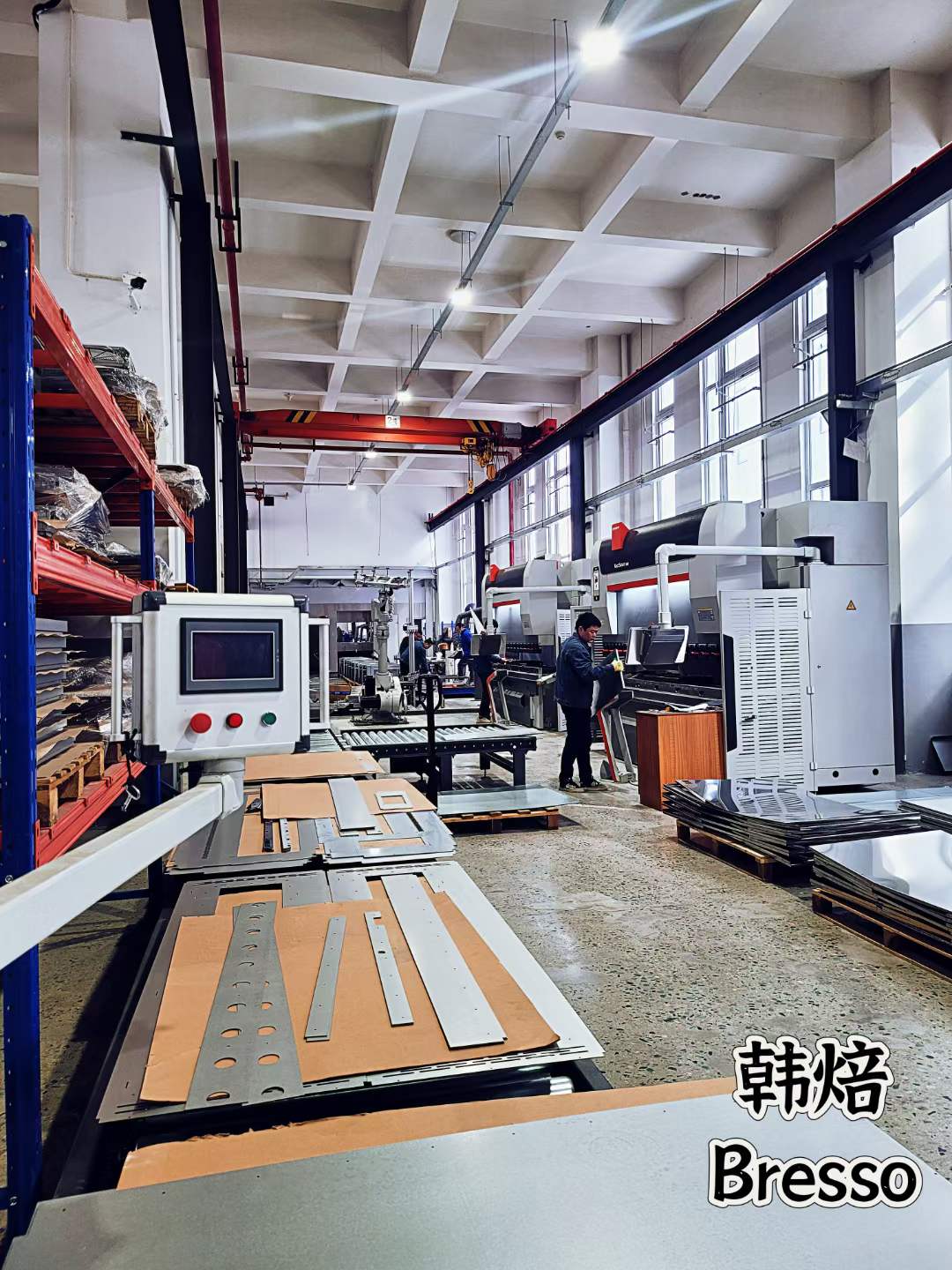
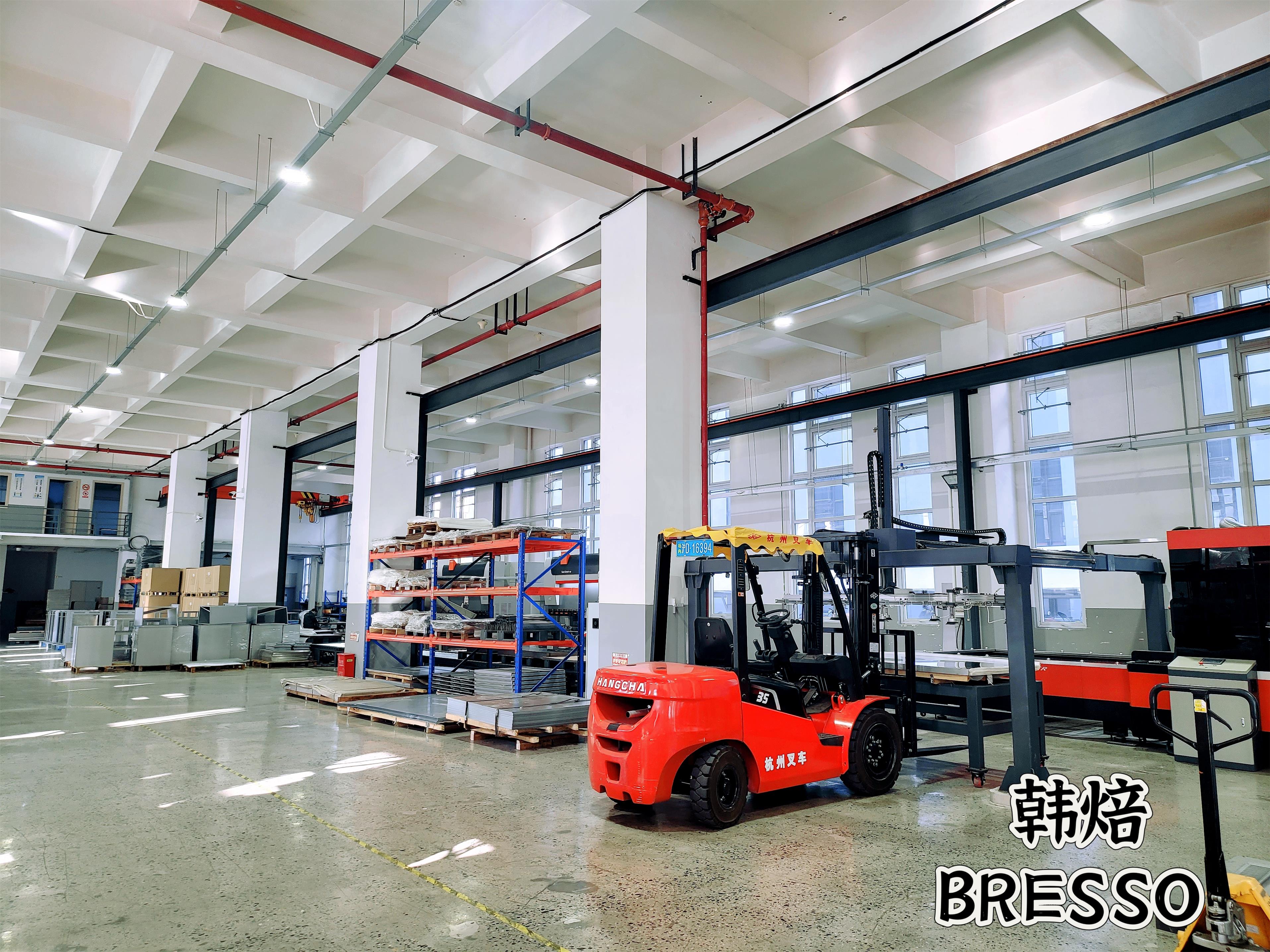
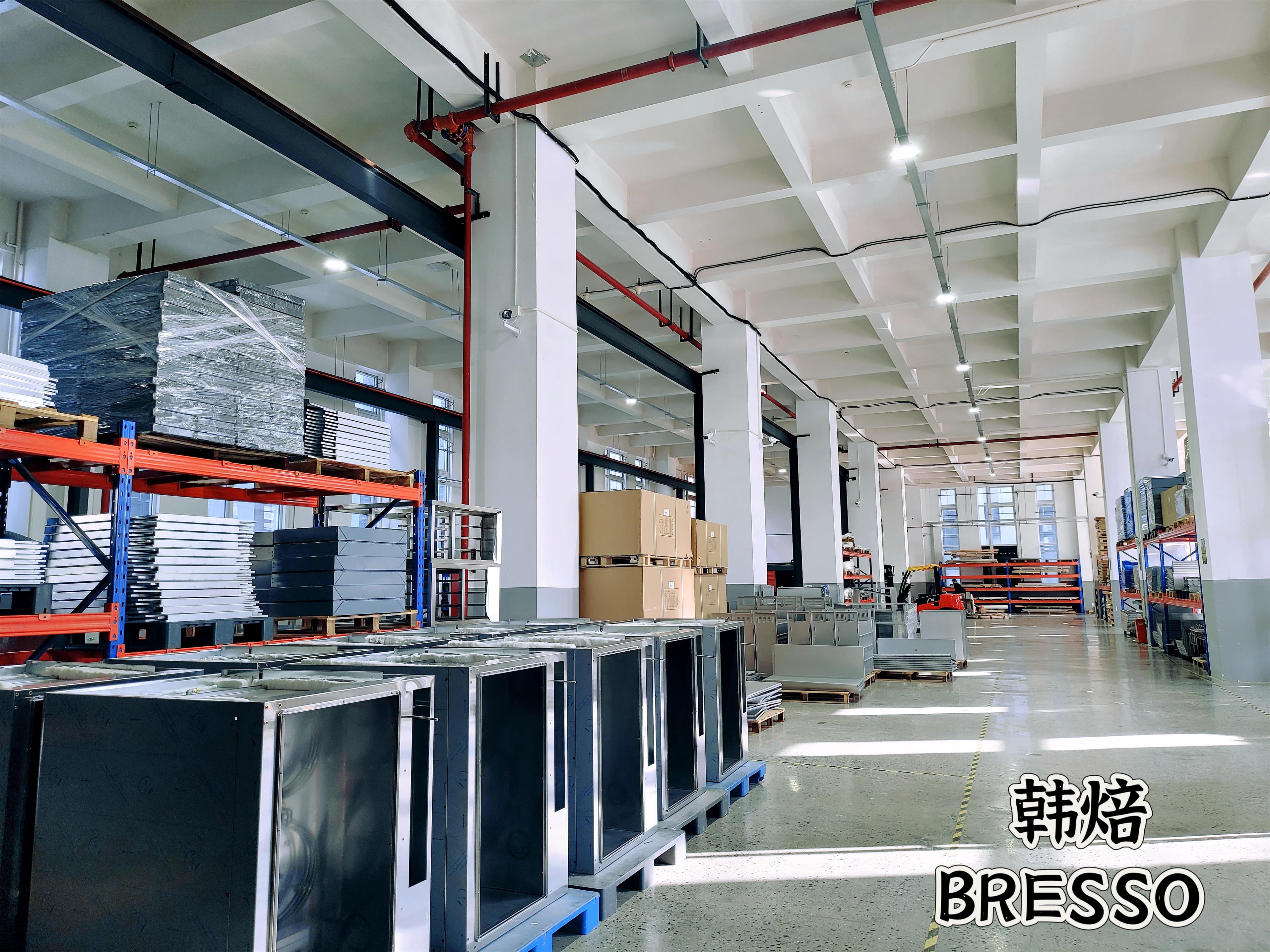
Repeatability at panel level depends on forming equipment. BRESSO states that its production base imported sheet-metal processing and bending equipment and robots from Bystronic Group in Switzerland. Controlled forming is what makes a stated thickness achievable unit after unit — and it is the reason a gauge figure is worth requesting in writing rather than accepting verbally during a factory visit.
Pillar 4 — Manufacturing Code Alignment: ISO9001, CE, FCC and Model-Level Scope
Manufacturing code alignment has two halves. The first is the quality-management code the factory is certified against. The second is the market-access mark attached to the exact model. BRESSO states ISO9001, CE and FCC among its international certifications, and these three answer different questions.
- ISO9001 describes the quality-management system the factory is audited against. It answers how process control, inspection and traceability are managed. It does not certify the electrical safety of any individual oven.
- CE is the European Union conformity route, evidenced by a declaration of conformity that names the model.
- FCC is the United States electromagnetic-compatibility route that applies to the electronics.
Where a North American safety listing is claimed, an ETL mark is verified through the Intertek ETL Listed Mark Directory rather than through a label photograph. This is also where smart features become a compliance topic: if a specification includes touch screen smart bakery ovens or remote monitoring bakery ovens, the control electronics fall inside the EMC documentation, so the declaration must cover the control configuration actually being shipped rather than a base model without it.
A practical rule closes this pillar. A company-level certification statement is not a model-level conclusion. Before signature, request the certificate with its issuing body, scope and validity date, and ask the supplier to identify the model or series the document covers.

Model Series and Their Rated Voltages
Four BRESSO series are most often requested in compliance documentation, and they divide into two rating groups. The table below states only documented figures and shows what should be attached to the purchase order for each.
| Series | Equipment category | Stated rated voltage | Attach to the purchase order |
|---|---|---|---|
| HBVO | Oven | 380 V | Nameplate photo, model datasheet, declaration of conformity for the destination market |
| HBWO | Deck oven | 380 V | Nameplate photo, model datasheet, declaration of conformity for the destination market |
| HCV | Oven | 380 V | Nameplate photo, model datasheet, declaration of conformity for the destination market |
| HBDC | Retarder-proofer | 220 V | Nameplate photo, model datasheet, declaration of conformity, proofing and retarding control documentation |
The table states only documented figures: the oven series at 380 V and the retarder-proofer series at 220 V. Category descriptions and panel specifications should be taken from the datasheet of the exact model quoted. In a dispute, the signed datasheet — not this table — is the reference document.
Step-by-Step: Aligning a Bakery Oven Order to Code
The sequence below converts the four pillars into a purchasing workflow. It is written so that each step produces a document, because undocumented steps are the ones that fail at inspection.
- Survey the site supply. Record nominal voltage, available capacity and earthing arrangements with a licensed electrician. Keep the record in the project file and reference it on the order.
- Match supply to series rating. Confirm that the selected series is 380 V or 220 V as applicable, and that the site can accept that rating without site-side modification. If it cannot, stop here and resolve it before pricing.
- Fix the protection package in writing. Require the protective device list — over-temperature power-off protection, leakage protection switch, insulated door, steam pressure relief valve, overcurrent and short-circuit protector — to appear on the quotation or technical annex.
- Specify material and construction. Write the stainless steel grade and panel gauge into the specification. Request the declared figure rather than accepting a general description of the body material.
- Assemble the manufacturing-code file. Collect the ISO9001 certificate with issuing body and scope, the CE declaration of conformity for the named model, FCC documentation for the electronics, and any ETL listing reference where a North American listing is claimed.
- Cross-check scope against model number. Confirm that each document covers the model or series being purchased. A certificate that names a different model is evidence of a different product.
- Define acceptance criteria. Set pre-shipment on-site inspection plus a third-party witness test as the acceptance route, and state the voltage, protection and construction points the witness should verify.
- Hand over the compliance file with the equipment. Ship the nameplate photograph, wiring diagram, protection device list, declaration of conformity and inspection record with the unit so the installer and the inspector work from the same documents.
Use Cases: Where Voltage and Code Alignment Change the Decision
Artisan bakery with steam production
An artisan bakery running artisan bread steam bakery ovens needs two things documented at once: the 380 V oven rating and the steam-side safety element. The controllable steam pressure relief valve is a protective device, not an accessory, so its presence belongs on the quotation and in the operator's handover pack. Steam capability without relief documentation leaves the installer without a reference point at commissioning.
Shop with a retarder-proofer alongside ovens
A commercial bakery shop combining ovens and a retarder-proofer is ordering two different ratings on one site: 380 V for the ovens and 220 V for the HBDC retarder-proofer. Treat them as two line items with two nameplates and two document sets. Collapsing them into a single 'oven package' is how a 220 V unit ends up specified against a 380 V assumption.
Chain rollout across multiple sites
A chain standardising on one series gets its largest compliance benefit from repetition, not from specification depth: one rating, one protection list, one document file replicated per site. Sites with different incoming supplies then become the exception to be resolved individually rather than the rule that delays every opening.
Distributor or importer entering a new market
A distributor building a tender file needs the market-access layer — an ETL listing verified in the Intertek directory for North America, a CE declaration naming the model for the European Union — plus the ISO9001 certificate that procurement teams ask for before technical evaluation begins. The three documents serve three different reviewers and are rarely interchangeable.
High-output manufacturing line ordering multiple units
A production line placing a multi-unit order faces a schedule problem and a compliance problem at the same time. Units must arrive together and carry consistent ratings. This is where documented monthly capacity and a defined lead time matter as much as the specification itself, because staggered arrival complicates the inspection record for the whole line.
Comparison: What Each Compliance Document Proves
Buyers frequently treat a certification pack as a single pass-or-fail item. It is more useful to read it as a set of narrow answers, each covering one question and no more.
| Document | What it evidences | What it does not prove |
|---|---|---|
| Model nameplate photograph | The rated voltage of the exact unit being shipped | That the site supply matches that rating |
| ISO9001 certificate with scope | That the factory's quality-management system is certified by a named body | Model-level electrical safety or performance |
| CE declaration of conformity | EU conformity route for the named model | Acceptance in North American markets |
| FCC documentation | US electromagnetic-compatibility route for the electronics | A product safety listing |
| ETL listing, checked in the Intertek directory | North American safety listing for the listed model | European market access |
| Protection device list and wiring diagram | Which protective functions are installed and how they are wired | Independent third-party test results |
| Pre-shipment inspection and third-party witness test | Conformance of the unit actually shipped | Long-term field reliability |
No single row in this table replaces a site inspection or a witness test. A complete file answers all of them, and a missing row identifies exactly which conversation still needs to happen before the purchase order is signed.
Commercial Terms That Keep a Compliance File Valid
Compliance is not a one-time event for a bakery that expands. It is a file that has to stay valid across repeat orders, additional sites and, for distributors, additional markets. The commercial terms below are the ones that determine whether that file survives the second and third order.
- Minimum order quantity: 2 units.
- Typical production lead time: 30 to 45 days.
- Monthly production capacity: 1,000 units.
- Production services: OEM and ODM production services are available.
- Delivery terms: FOB / CIF.
- Payment terms: T/T; L/C irrevocable at sight.
- Acceptance criteria: pre-shipment on-site inspection plus a third-party witness test.
Two of these terms carry direct compliance weight. A minimum order of 2 units allows a buyer to validate one unit against the document file before committing a full site — the cheapest point at which a voltage or protection discrepancy can still be corrected. And a witness test before shipment places the verification step where a correction is still possible, rather than after the container has arrived.
For a distributor or chain operator, documented monthly capacity of 1,000 units and a 30 to 45 day lead time turn repeat ordering into a planning exercise. The compliance benefit is indirect but real: when the same series is reordered at the same rating from the same factory, the existing certificate pack, declaration of conformity and inspection routine remain applicable, and each new site starts from a file rather than from zero.
Frequently Asked Questions
What voltage should a commercial bakery oven be rated for?
BRESSO states 380 V for its ovens and 220 V for its retarder-proofers. The nameplate figure must be matched against the site's nominal supply before the order is confirmed. Where the two do not match, the difference has to be resolved in writing on the order — either through a site-side transformation agreed with the installer, or through a factory-confirmed configuration — rather than left to commissioning day.
Which manufacturing-code documents should be requested before signing a purchase order?
Request the ISO9001 certificate with its issuing body, scope and validity date; the CE declaration of conformity naming the model; FCC documentation covering the electronics; and, where a North American safety listing is claimed, the ETL listing reference so it can be checked in the Intertek ETL Listed Mark Directory. Add the protection device list and the wiring diagram, so the electrical evidence matches the physical unit rather than the company brochure.
Can one supplier support a multi-year, multi-unit oven program?
BRESSO states a monthly production capacity of 1,000 units, a minimum order quantity of 2 units, a typical production lead time of 30 to 45 days, and the availability of OEM and ODM production services. For a long-term program the practical test is whether repeat orders can be placed against the same series and the same rating, because that is what keeps one compliance file usable across multiple sites and multiple years.
What commercial terms apply to a long-term bakery oven supply arrangement from China?
The stated purchasing terms are a minimum order quantity of 2 units, delivery on FOB or CIF terms, and payment by T/T or by irrevocable L/C at sight. Acceptance is set as pre-shipment on-site inspection plus a third-party witness test. For budgeting purposes these terms matter more than headline pricing, because the acceptance route determines when a non-conformance is discovered and who bears the cost of correcting it.
How is an oven validated before shipment, and how long does that take?
Validation follows the stated acceptance criteria: pre-shipment on-site inspection plus a third-party witness test, scheduled inside a typical production lead time of 30 to 45 days. A trial order can start at the 2 unit minimum, which allows a single unit to be checked against the voltage, protection and construction points in the document file before a larger site order is released.
Conclusion: Compliance Is a Document Trail, Not a Claim
Voltage standards and manufacturing code alignment are the two compliance questions a bakery oven buyer can actually settle before the purchase order is signed. The first is answered by a nameplate: 380 V for the oven series, 220 V for the retarder-proofer series, matched against the site supply in writing. The second is answered by a file: ISO9001 with a defined scope, CE and FCC documentation, an ETL listing verified where claimed, and a protection device list that matches the wiring diagram on the unit that ships.
Stainless steel construction belongs to the same conversation. It is a specification with a grade and a gauge, not a finish descriptor, and it should appear on the quotation in the same way the voltage does. Buyers who insist on both — the number and the document behind it — are the ones whose installations pass inspection on the first attempt.
Request the Compliance File for Your Market
BRESSO supplies bakery ovens and retarder-proofers with documented voltage ratings, protective device lists and manufacturing-code documentation. Share your destination market, site supply and required series — HBVO, HBWO, HCV or HBDC — and request the model datasheet, certificate scope and acceptance terms before your next purchase order.
Product brochure (PDF): BRESSO Product Brochure 2026
Website: bresso-oven.com
Email: re@bresso-oven.com
WhatsApp: +8615901736616
Address: Building 16, No.258, Yinlong Rd, Jiading District, Shanghai, CHINA
Have Questions or Need More Details?
Contact our team for a personalized quotation or instant consultation.
Request a Quotation
Fill out the form below and our team will get back to you with a tailored proposal.
WhatsApp Direct Chat
Prefer to chat in real-time? Message us on WhatsApp for instant assistance & quick answers.
- Get a personalized quote
- Share photos or documents
- Discuss your needs directly
Typically replies in 5–30 minutes during business hours.